

Electrically insulated bearings are no longer an optional “add-on” for premium motors; in VFD-driven and high-voltage applications, they are a core design feature that OEMs must specify correctly from day one. Getting the specification right at the design stage avoids later field retrofits, warranty claims, and reputational damage from unexplained bearing failures.
Why New Motor Designs Need Insulated Bearings
Modern motors increasingly operate from PWM inverters, long-shielded cables, and higher DC bus voltages, all of which increase common-mode voltage and shaft-current risk. Standard steel bearings form part of the capacitive network between stator, rotor, and frame, so high-frequency currents can discharge through the lubricant film and raceways, causing electrical pitting, fluting, and premature failure.
Specifying insulated bearings at design time ensures that at least one current path through the bearings is blocked, enabling the motor to meet its expected L10 life when used on VFDs without ad hoc grounding fixes in the field.
Step 1: Define Electrical Requirements
Before choosing bearing types, OEM engineers should quantify the electrical environment of the new motor platform.
- Drive system: DC bus voltage, maximum output voltage, switching frequency range, and expected common-mode spectrum.
- Cabling: Typical and maximum cable lengths and types, as cable capacitance has a major influence on common-mode currents.
- Application profile: Duty cycles, speed ranges, and whether motors will be used in multi-motor or regenerative systems.
Based on these factors, set target limits for acceptable shaft-to-frame voltage and bearing current, then work backward to determine the insulation resistance and dielectric strength requirements for the bearings.

Step 2: Choose the Insulation Concept
There are three main bearing-related insulation concepts OEMs use in new designs.
Ceramic-Coated (Insulated) Bearings
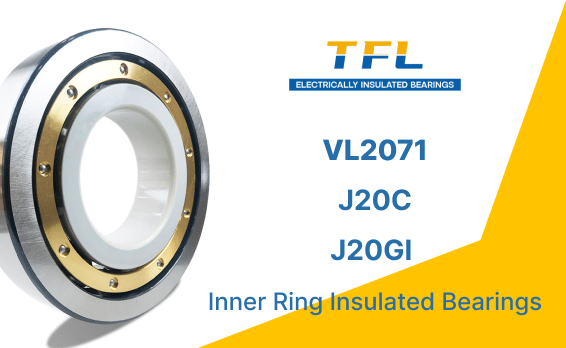
These have a plasma-sprayed ceramic layer, usually alumina, on the outer or inner ring and are widely used in industrial motors.
Pros:
- Drop-in ISO dimensions and standard mechanical load ratings.
- High insulation resistance (tens of megaohms at 500–1000 V DC) and robust dielectric strength.
- Mature, cost-effective technology for frame sizes from small IEC up to large generators.
Cons:
- Coating adds some thermal resistance and requires controlled fits.
- If only one ring is coated, current paths through other bearings or couplings still exist.

Hybrid Ceramic Bearings
Hybrid bearings use steel rings and ceramic rolling elements (typically silicon nitride).
Pros:
- Non-conductive balls break the current path at the rolling contact.
- Lower mass and reduced centrifugal forces improve high-speed performance.
- Often lower friction and improved efficiency.
Cons:
- Higher cost than coated bearings.
- Different dynamic behaviour and impact sensitivity that must be accounted for in design.
System-Level Insulation
In some designs, OEMs combine insulated bearings with insulated couplings or polymer housings to create multiple barriers. This approach is common in integrated e-drives and gearmotors where the mechanical package is fully under their control.
Step 3: Decide Which Bearings to Insulate
For a new motor platform, specifying where to place insulated bearings is as important as choosing the type.
- Small and medium VFD motors: One insulated bearing—often at the non-drive end (NDE)—usually suffices to break most circulating current loops.
- Larger frame motors: Best practice is often insulated bearing on one end plus a shaft grounding ring on the opposite end to handle both common-mode capacitive currents and rotor-to-frame loops.
- Motors directly coupled to sensitive equipment: If driven pumps or gearboxes have a history of bearing currents, OEMs may specify insulated bearings on the motor NDE and recommend or supply insulated bearings in the driven equipment as part of a package.
Documenting these configurations in the motor family datasheets helps end users and system integrators standardize their grounding and insulation strategies.
Common Electrically Insulated Bearing Series for VFD Motors
To assist in your specification process, here is a list of commonly specified insulated bearing sizes used in industrial motors (IEC Frame 160–355). These models feature ceramic oxide coatings (Inner or Outer Ring) designed for ≥1000V DC breakdown voltage.
| ISO Designation (Base) | Bore (mm) | OD (mm) | Width (mm) | Common Coating Type | Application Note |
| 6210 / NU 210 | 50 | 90 | 20 | Outer Ring (J20AA) | Small VFD Motors |
| 6310 / NU 310 | 50 | 110 | 27 | Outer Ring (J20AA) | Robust NDE Solution |
| 6314 / NU 314 | 70 | 150 | 35 | Outer Ring (J20AA) | Medium Frame Motors |
| 6316 / NU 316 | 80 | 170 | 39 | Inner/Outer Coated | Common in 75kW+ |
| 6319 / NU 319 | 95 | 200 | 45 | Outer Ring (J20AA) | Heavy Duty Pumps |
| 6322 / NU 322 | 110 | 240 | 50 | Outer Ring (J20AA) | Large Fans/Blowers |
| 6326 / NU 326 | 130 | 280 | 58 | Inner Ring (J20C) | High Load VFD |
| 6330 / NU 330 | 150 | 320 | 65 | Outer Ring (J20AA) | Traction/Generators |
(Note: Custom dimensions and hybrid ceramic options are also available based on specific OEM load requirements.)
Step 4: Specify Electrical Performance Parameters
A robust OEM specification must state clear, testable electrical properties for insulated bearings.
Key parameters include:
- Insulation resistance: For example, ≥ 50 MΩ at 500 V DC between inner and outer rings, measured at 25 °C with defined humidity.
- Dielectric strength / breakdown voltage: Minimum withstand voltage, e.g., ≥ 1000 V DC for standard industrial motors or higher for specific high-voltage lines.
- Leakage current limits: Maximum permissible leakage at rated test voltage, where required by end-user standards.
These values should align with expected shaft voltage levels and provide adequate margin for long-term ageing, contamination, and moisture effects.
Step 5: Define Mechanical and Thermal Requirements
Insulated bearings must also meet all conventional bearing design needs.
- Load ratings: Static and dynamic capacities equal to or exceeding those of standard steel bearings in the same size.
- Speed limits: Capable of the highest intended speed with appropriate lubrication and cooling.
- Fits and tolerances: Account for coating thickness on outer/inner ring—catalogues from major suppliers specify recommended housing and shaft fits for coated bearings.
- Thermal behaviour: Ensure the coating’s thermal resistance does not create unacceptable temperature rise at the bearing in high-load or poorly cooled designs.
For hybrid bearings, specify allowable misalignment, shock load limits, and lubrication regimes since ceramic balls can respond differently than steel.

Step 6: Environmental and Standards Considerations
OEM specifications should reflect the environments motors will face.
- Humidity and contamination: In wet or dusty applications, choose coatings with low porosity and sealed surfaces so insulation resistance stays high even when surfaces get damp.
- Chemicals and corrosion: Consider special ceramic or polymer solutions where chemicals could attack standard coatings.
- Industry standards: Align with IEC or NEMA guidance on VFD-ready motors and any sector-specific standards (e.g., marine, mining, explosive atmospheres) that affect insulation and grounding requirements.
This ensures the motor line can be applied globally without redesign for each market.
Step 7: Document Test Methods and Quality Assurance
To avoid ambiguity between OEMs and bearing suppliers, specify test procedures explicitly.
- Routine tests: Insulation resistance test at specified DC voltage on each insulated bearing or per batch, with acceptance criteria.
- Type tests: High-potential (hipot) and surge tests, thermal cycling, vibration endurance, and adhesion tests on coatings to validate new designs.
- Incoming inspection: Guidance for OEM factories on sample testing and handling practices to prevent damage during assembly.
Including these in the motor design standard makes insulated bearing performance auditable and repeatable across plants and suppliers.

Step 8: Coordinate with Drive, Cable, and Grounding Design
Electrically insulated bearings cannot be specified in isolation; they are part of the total common mode impedance network.
OEM motor design teams should collaborate with:
- Drive manufacturers: To understand planned switching frequencies, built-in filters, and recommended shaft-voltage limits.
- Cable suppliers: To select cable types and lengths that manage capacitance and common-mode current.
- System integrators: To define grounding and bonding practices, including whether shaft grounding rings or common-mode chokes will be standard.
This collaboration ensures the insulated bearings operate within their design envelope and deliver the expected reduction in electrical stress.
Example Specification Snapshot (for a VFD-Ready Motor Series)
An OEM electrical and mechanical specification for a 400 V–690 V VFD-ready motor line might include:
Bearing type:
- Deep-groove ball bearings with ceramic-coated outer ring on NDE for frames ≥ IEC 160; hybrid bearings optional for high-speed variants.
Electrical rating:
- Insulation resistance ≥ 100 MΩ at 500 V DC (inner ring to outer ring).
- Dielectric withstand ≥ 1500 V DC, 1 minute, no breakdown or flashover.
Mechanical rating:
- Dynamic load rating equal to standard bearing of the same size.
- Max speed per catalogue with C3 clearance and specified grease.
Environmental rating:
- Coating porosity < specified value; passed 96-h salt spray test without loss of insulation class.
System guidance:
- Shaft grounding ring on drive end recommended for frames ≥ 280.
- Motor certified as “VFD-ready” when used with specified cable and drive filter options.
This kind of concise yet quantitative snapshot helps sales, applications, and customers understand exactly what “electrically insulated bearings” mean for that design.
Ensure Your Next Motor Design is Built to Last
At TFL Insulated Bearings, we understand that specifying the right insulation solution is critical to protecting your reputation as an OEM. We don’t just supply parts; we partner with your design team to validate electrical resistance, load capacity, and coating durability under real-world VFD conditions. Whether you need standard dimensions for a rapid prototype or a custom coating for a high-voltage application, we are ready to support your engineering goals.
Ready to secure your motor reliability?
- Contact us for a technical consultation on your current design.
- Request a Quote for our premium insulated bearing series.
- Email us directly at [email protected] with your specifications.
- Call us at +86 15806631151 for immediate assistance.
Let’s build the next generation of reliable VFD motors together.