

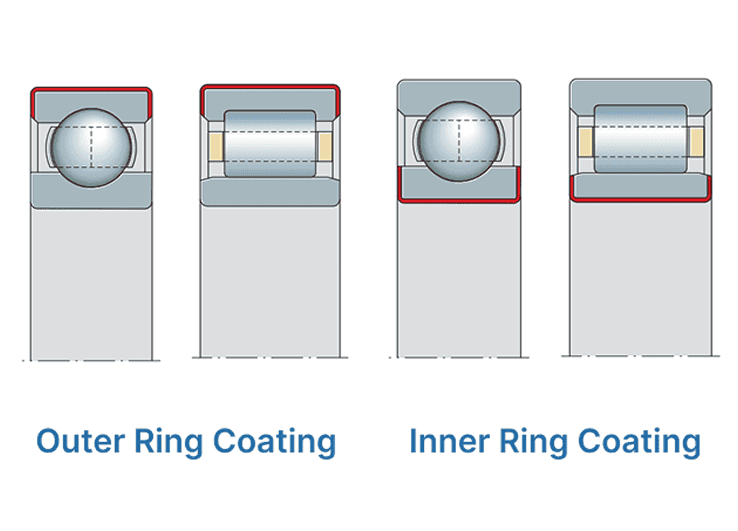
Outer Ring Insulation (e.g., SKF VL0241, FAG J20AB) has the coating on the outer diameter. It is the industry standard for 90% of electric motors where the housing is stationary and the shaft rotates.
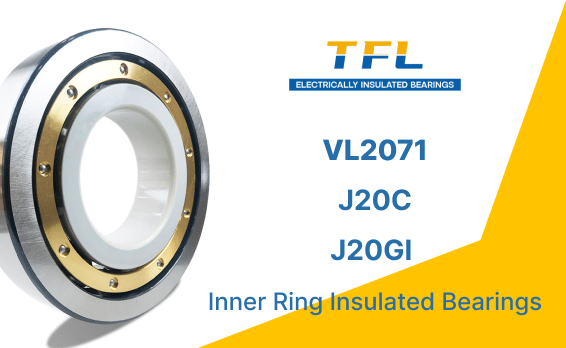
Inner Ring Insulation (e.g., SKF VL2071, FAG J20AA) has the coating on the bore. It is used in specialized applications where the outer ring rotates, or where the housing fit is too tight for a coated surface.
If you’ve ever stared at a bearing catalog trying to decipher the difference between VL0241 and VL2071, or J20AA and J20AB, you are not alone.
Buying the wrong insulated bearing isn’t just a paperwork error—it’s a mechanical risk. Installing an inner-coated bearing when your application demands an outer-coated one can lead to cracked insulation during installation or immediate electrical leakage due to improper grounding paths.
In this guide, we strip away the confusing suffix codes and look at the physical engineering. By the end of this post, you will understand:
- The mechanical differences between Inner vs. Outer ring coatings.
- Why 90% of the market uses Outer Ring Insulation (and when you shouldn’t).
- How to read the “Secret Code” suffixes from SKF, FAG, and NKE.
- Bonus: A simple decision flowchart to prevent purchasing errors.
The Core Difference: Where is the Coating Applied?
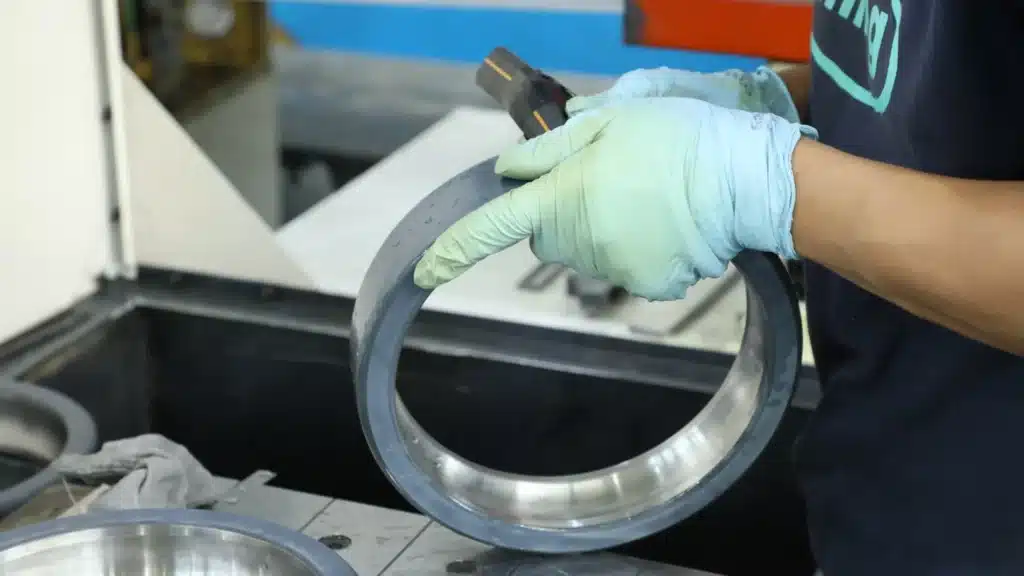
Insulated bearings (often called electrically insulated bearings or current-insulated bearings) look identical to standard bearings at a glance. The magic lies in a thin layer of aluminium oxide (Al2O3) plasma-sprayed onto one of the bearing rings.
This layer, usually between 100μm and 300μm thick, acts as a resistor, blocking stray currents (EDM currents) from passing through the rolling elements and damaging the raceways.
1. Outer Ring Coated (The Industry Standard)
Common Suffixes: SKF VL0241, FAG J20AB, NKE SQ77
In this configuration, the insulation is applied to the External Surface (Outer Diameter) of the outer ring. This is the default configuration for the vast majority of electric motors, generators, and variable frequency drives (VFDs).
Why is it the standard?
- Stationary Housing: In most motors, the outer ring sits in a stationary housing. The insulation layer is less likely to be damaged by centrifugal forces (though modern plasma spraying has largely solved this, the convention remains).
- Easier Installation: Housing fits are typically “Transition Fits” (H7/g6) or loose fits. This means you don’t need to heat the housing significantly, reducing the risk of thermal shock to the coating during installation.
2. Inner Ring Coated (The Specialized Solution)
Common Suffixes: SKF VL2071, FAG J20AA, NKE SQ77E
Here, the ceramic coating is applied to the Bore (Inner Diameter) of the inner ring. You will typically see this on the shaft side.
When do you need this?
- Rotating Outer Ring Applications: If the application involves a rotating housing (e.g., certain fan hubs or shaker screens), an inner ring coating is preferred to ensure the insulation remains stable on the stationary shaft.
- Undersized Housings: Sometimes, a motor housing is re-machined or has a very tight interference fit that might crush an outer coating. In these cases, moving the insulation to the inner ring (shaft side) is a strategic alternative.
Installation Scenarios: Static vs. Rotating Fields
The choice between Inner and Outer ring insulation isn’t just about preference; it’s about physics. The golden rule in bearing application engineering is: Insulate the Stationary Ring whenever possible.
The “Stationary Ring” Rule
In 95% of industrial motors, the Stator (Housing) is stationary, and the Rotor (Shaft) rotates.
Because the outer ring is stationary in the housing, it is subjected to less mechanical stress compared to the rotating inner ring. The insulation coating on the outer ring is less likely to suffer from:
- Centrifugal Forces: While modern plasma spraying is robust, placing a ceramic layer on a high-speed rotating inner ring introduces unnecessary stress.
- Thermal Expansion Mismatch: The inner ring gets hotter than the outer ring. A ceramic coating on the hottest part of the bearing (the inner ring) is under higher thermal stress than one on the cooler outer ring.
This is why Outer Ring Insulation (VL0241 / J20AB) is the default stock item for most distributors. It aligns with the standard motor configuration.
Comparison: Mechanical Risks & Heat Dissipation
If you are retrofitting a motor or designing a new system, you must consider the installation risks. This is where the difference between Inner and Outer coatings becomes critical.
1. Installation Damage: The “Interference Fit” Danger
The biggest risk to insulated bearings happens during installation.
- Outer Ring (Safe): Motor housings typically use a Transition Fit (e.g., H7) or a loose fit. You can often slide the bearing into the housing with minimal force or light heating. The coating is safe.
- Inner Ring (Risky): Shafts typically use an Interference Fit (e.g., k5, m5). To install the bearing, you must heat it to expand the inner ring.
I have seen many technicians accidentally destroy Inner Ring Insulated bearings (VL2071 type) before the motor even starts.
The problem is the Induction Heater. If you place the induction bar directly through the bore of an inner-coated bearing, the rapid localized heating can cause the steel inner ring to expand faster than the ceramic coating. This causes the insulation to crack or flake off (micro-spalling).
My Advice: If you must use an Inner Ring Insulated bearing, heat it slowly and evenly. Never exceed 110°C, and use a temperature-controlled induction heater to avoid thermal shock to the coating.
2. Heat Dissipation Myths
A common myth is that the ceramic insulation acts like a “thermal blanket,” trapping heat inside the bearing and causing it to fail.
The Reality: The aluminium oxide layer is incredibly thin—typically 100μm to 300μm (0.1mm – 0.3mm). While ceramic is a thermal insulator, the layer is so thin that its effect on overall heat transfer is negligible.
Whether you choose standard insulated bearings (Outer Coated) or specialized ones (Inner Coated), the heat dissipation capacity is effectively the same. Do not base your decision on cooling; base it on the mechanical fit.
Decoding the Suffixes: SKF vs. FAG vs. NKE
The most confusing part of buying insulated bearings is that every manufacturer speaks a different language. While SKF uses “VL” codes, FAG uses “J20” codes.
Here is the definitive cheat sheet to ensure you order the right part.
| Brand | Outer Ring Coated (Standard) | Inner Ring Coated (Special) | Voltage Spec |
|---|---|---|---|
| SKF | VL0241 (Most Common) | VL2071 | 1000V DC |
| FAG (Schaeffler) | J20AB (Prev: J20B) | J20AA (Prev: J20A) | 1000V – 3000V |
| NKE | SQ77 | SQ77E | 1000V |
| NSK | HD / gxx | (Special Order) | Varies |
Note on Voltage: Standard coatings (VL0241) handle up to 1000V DC. For high-voltage applications (>3000V), look for suffixes like SKF VL2076 or FAG J20C.
💡 Need to match an old part number? Use our free Insulated Bearing Cross-Reference Tool to instantly find the equivalent model from different brands.
[Practical Guide] The Selection Flowchart
Still not sure which one to buy? Follow this simple 3-step decision matrix. It works for 99% of standard induction motor applications.
Step 1: Identify the Rotating Ring
- Housing Static / Shaft Rotating: Go to Step 2. (This is 90% of motors).
- Housing Rotating / Shaft Static: STOP. You need Inner Ring Insulation (VL2071 / J20AA).
Step 2: Check the Housing Fit
- Loose / Transition Fit (H7/g6): You are safe. Use Outer Ring Insulation.
- Tight Interference Fit: If the housing is extremely tight, the outer coating might crack during press-fitting. Switch to Inner Ring Insulation.
Step 3: Check Availability (The Tie-Breaker)
If Step 1 and 2 don’t force a specific choice, always choose Outer Ring Insulation (VL0241 / J20AB).
Why? Because it is a stock item. Inner ring coated bearings are often “Made to Order” with 12+ week lead times. Don’t let a simple maintenance job turn into a 3-month shutdown.
When to Switch to Hybrid Ceramic?
If you are dealing with high-frequency VFDs where voltage spikes exceed 3000V, standard coatings (Inner OR Outer) might not be enough. In that case, you need Hybrid Ceramic Bearings (HC5 / HC20).
Ready to replace your motor bearings?
View In-Stock Insulated Bearings »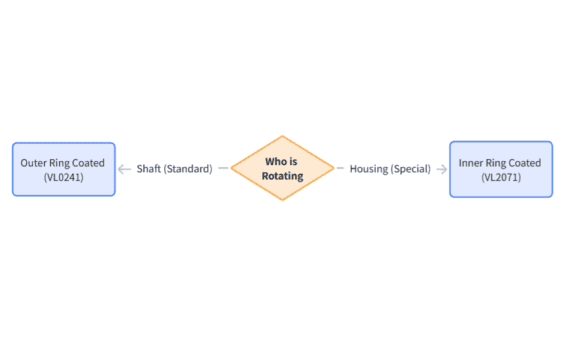
Frequently Asked Questions
Can I replace a VL0241 (Outer Coated) with a VL2071 (Inner Coated)?
Technically, yes, if the dimensions are identical. However, you must be extremely careful during installation. Inner ring coated bearings (VL2071) cannot be heated rapidly with a standard induction heater, or the coating will crack. We recommend sticking to the original specification unless you have specialized heating tools.
Which coating is better for VFD motors?
Both Inner and Outer ring coatings use the same Aluminium Oxide material and offer similar electrical resistance (usually 1000V DC). The “better” choice depends on your mounting fit. For standard motors, Outer Ring Insulation (VL0241/J20AB) is better because it is safer to install and easier to source.
What happens if I scratch the insulation layer?
If the ceramic coating is chipped or deeply scratched, its dielectric strength is compromised. High-frequency currents will find the path of least resistance through that scratch, leading to arcing and premature bearing failure. If you drop an insulated bearing, do not install it.
Does the insulation affect the bearing’s load capacity?
No. The coating is applied to the non-load-bearing surfaces (OD or Bore). The raceways and rolling elements are standard steel. Therefore, the dynamic and static load ratings remain exactly the same as a standard non-insulated bearing.
Avoid Costly Motor Failures Today
Don’t let confusing part numbers stop your production line. Whether you need VL0241, VL2071, or a custom insulated solution, we have them in stock.
Fast Shipping | Technical Support Available