
If your motor bearings are damaged by shaft current, TFL insulated bearings are the ideal solution.
You can choose electrically insulated bearings (with ceramic coating) or ceramic bearings as replacements. Both types of insulated bearings can directly replace standard bearings in size and structure, while effectively blocking shaft currents to protect the motor from electrical damage.
This article compares these two types of electrically insulated bearings in detail. Whether you work in motor design, equipment maintenance, or industrial procurement, this guide will help you decide which insulation structure best suits your equipment and budget.
Summary
- Ceramic-coated insulated bearings: A ceramic material such as alumina is sprayed onto the surface of the inner or outer ring to form an insulating layer. Offers excellent cost-performance ratio.
- Hybrid ceramic bearings: The rolling elements are made of ceramic material, while the inner and outer rings are steel. These combine good insulation performance with lower cost.
- Full ceramic bearings: The rolling elements, inner ring, and outer ring are all made of ceramic. These provide outstanding insulation and corrosion resistance, but come at a higher cost.
When Motors Need Insulated Bearings
Not all motors require insulated bearings. You should consider using them when one or more of the following conditions apply, as they help prevent shaft current and bearing damage:
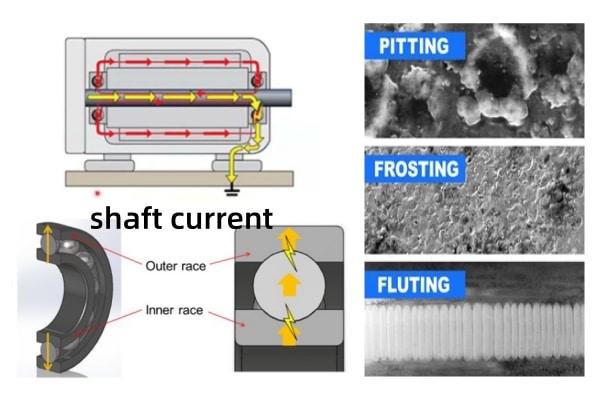
- Motors powered by frequency converters (inverters): Inverter-driven motors generate high-frequency common-mode voltages, which induce shaft voltages that create bearing currents. These currents can cause electrical pitting and premature bearing failure.
- Large motors: Even without inverter supply, large-capacity motors can develop shaft currents due to magnetic field imbalance.
- High-speed motors: Bearings in high-speed motors are more susceptible to shaft current damage.
- Motors in harsh environments: Motors operating in humid or corrosive atmospheres are more prone to bearing damage. Insulated bearings enhance reliability in such conditions.
- Motors with special requirements: For applications with strict vibration and noise limits, insulated bearings can help reduce vibration and noise caused by electrical discharge.
If your motor does not meet these conditions, or if shaft current effects are negligible, standard steel bearings are usually sufficient and more economical.
Ceramic-Coated Insulated Bearings
What Is an Insulating Coating?
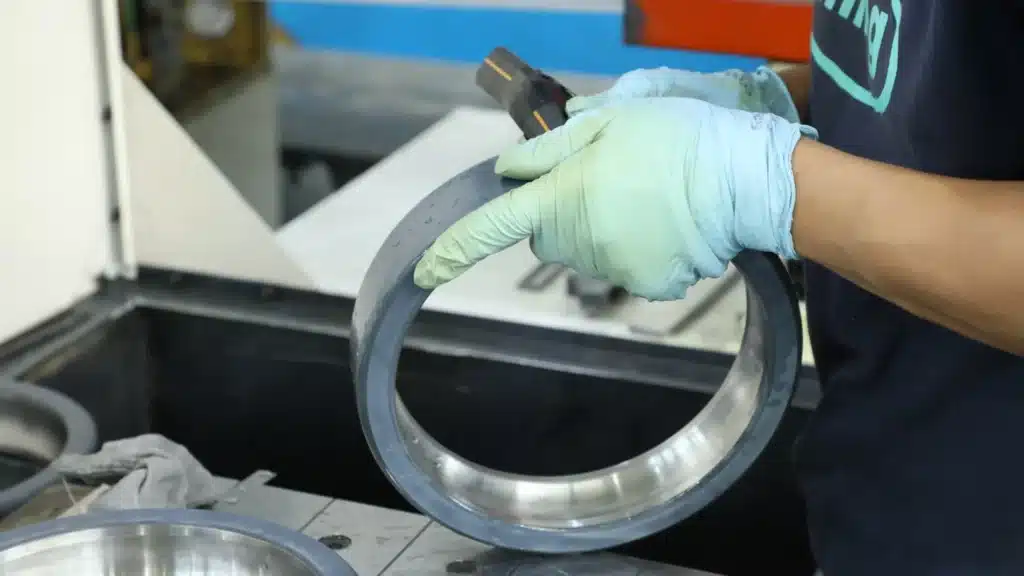
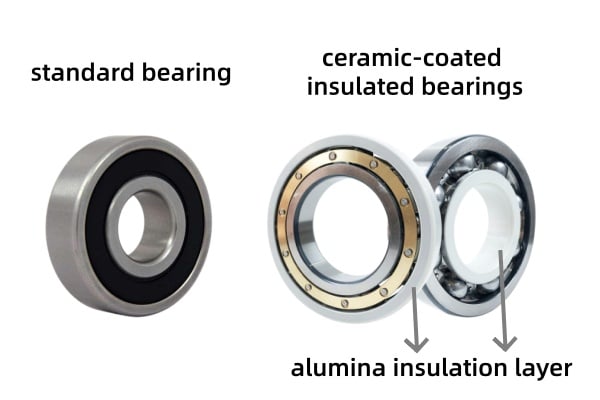
An electrically insulated ball bearing is a modified standard ball bearing. As shown below, the inner or outer ring surface is coated with a white, gray, or black ceramic insulation layer—typically alumina (Al₂O₃) or silicon nitride (Si₃N₄). This “protective film,” formed through a thermal spraying process, effectively blocks electrical current paths, preventing electrical erosion, while the core bearing remains high-quality bearing steel.
TFL Plasma Spraying Technology
At TFL, we use advanced plasma spraying technology to create durable insulating coatings. This high-performance thermal spraying process ensures excellent adhesion between the coating and the bearing surface.
Test results show:
- After 10,000 hours of continuous operation, coating wear is less than 0.01 mm
- Adhesion strength ≥ 5 MPa
Thanks to this superior bond strength, TFL’s insulating coatings have an extremely low risk of delamination, ensuring long-term stability and reliability for motors and other rotating equipment.
TFL’s plasma process achieves excellent coating uniformity, with thickness precisely controlled between 50–500 μm (customizable based on application). This ensures effective insulation without affecting the bearing’s original dimensions or performance parameters.
Therefore, TFL insulated bearings are fully interchangeable with standard bearings in terms of inner/outer diameter, width, weight, load capacity, and speed.
Ceramic Coating Cost
The cost of a ceramic-coated insulated bearing mainly depends on material and spraying process costs.
- Coating materials: Typically high-purity alumina (Al₂O₃) powder, with optional high-performance materials like silicon nitride (Si₃N₄) or zirconia (ZrO₂).
- Alumina is the most economical and widely used option; Si₃N₄ and ZrO₂ provide higher dielectric strength and impact resistance but are more expensive to process.
The plasma spraying process represents the largest cost component. While it raises coating costs by around 10–20% compared with conventional methods, it enhances insulation performance and bearing life by 2–3 times.
Overall, TFL insulated bearings are far more cost-effective than hybrid or full ceramic bearings (which can cost 100–300% more).
Hence, ceramic-coated bearings provide the best balance of insulation, reliability, and economy, making them ideal for motors, generators, and inverter-driven systems.
For product inquiries:
Phone: +86 15806631151
Email: info@sdtflbearing.com
TFL’s standard insulating coatings can withstand ≥1000V DC, with custom options from 500V to 5000V DC available.
Hybrid Ceramic Bearings vs. Full Ceramic Bearings
High-Performance Ceramic Materials
- Silicon nitride (Si₃N₄): High strength, low density, excellent hardness, superior insulation, and low thermal expansion—ideal for high-speed and high-temperature applications.
- Zirconia (ZrO₂): High toughness and corrosion resistance, suitable for humid or chemically active environments.
- Alumina (Al₂O₃): Excellent insulation and cost-effectiveness, widely used for economic applications.
- Silicon carbide (SiC): Extremely hard, lightweight, and thermally conductive—ideal for harsh conditions.
Structural Classification
Hybrid Ceramic Bearings
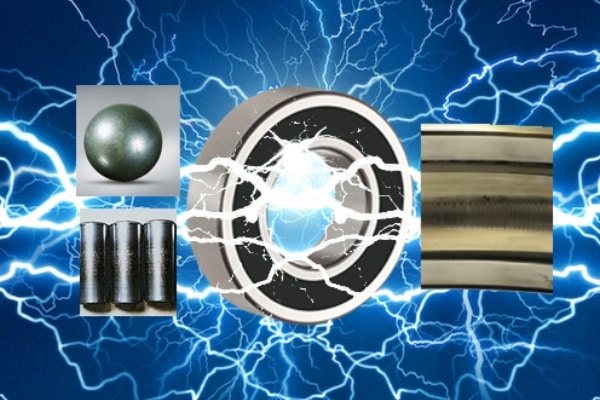
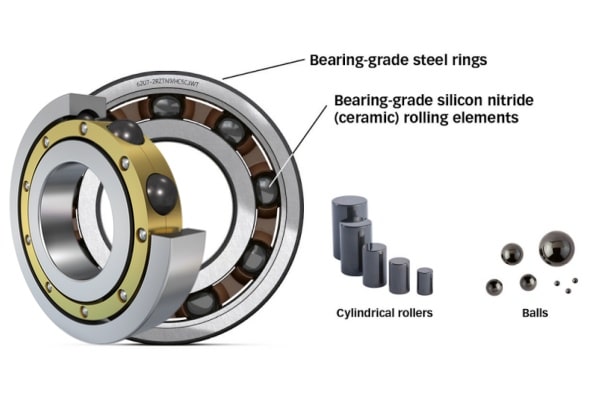
In hybrid ceramic ball bearings, the steel rolling elements are replaced with silicon nitride material (sometimes zirconium oxide (ZrO₂) is also used). Compared to steel balls, ceramic materials are good insulators and can effectively block current from passing through the bearing, preventing electrochemical corrosion and bearing damage. Especially in equipment where current leakage may occur, such as inverter motors and wind turbines, hybrid ceramic bearings can prevent surface burning and pitting of the bearings. Typical applications: inverter-driven motors, servo motors, wind turbines, CNC spindles, and high-speed compressors.
Full Ceramic Bearings
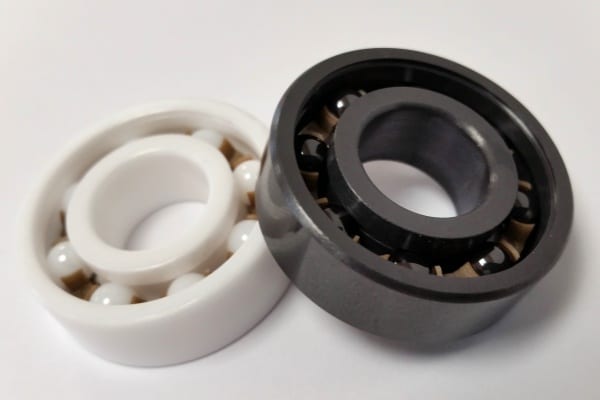
All main components of these bearings, including the inner ring, outer ring, and rolling elements, are made of ceramic materials. Commonly used ceramic materials include zirconium oxide (ZrO₂), silicon nitride (Si₃N₄), and silicon carbide (SiC).
This structure offers extremely high corrosion resistance, insulation, and high-temperature stability, and can operate without lubrication, in vacuum, or in strong corrosive media.
Despite higher manufacturing costs and relatively greater brittleness, it can still maintain excellent performance stability under extreme working conditions.
Typical applications: chemical equipment, vacuum pumps, semiconductor machinery, aerospace, and precision instruments.
Ceramic Bearings: Advantages and Disadvantages
Advantages
Long Service Life
Ceramic materials have high hardness and wear resistance, and the rolling element surface is extremely smooth, reducing friction and heat generation. Full ceramic bearings have a lifespan 10-50 times that of steel bearings, and hybrid ceramic bearings can achieve 3-5 times.
Corrosion and High-Temperature Resistance
Ceramics do not rust and do not react with most chemical media, allowing them to work long-term in acid-base or high humidity environments; some materials (such as SiC, Si₃N₄) can maintain strength at high temperatures of 800–1200°C. In 800°C high temperature, strong acid corrosion, or vacuum environments, metal bearings may fail in a few hours, while ceramic bearings can still operate stably.
Natural Insulation
Ceramics are non-metallic insulators that can completely block current from passing through the bearing, fundamentally preventing electrochemical damage, especially suitable for inverter drives, generators, and electric vehicle drive motor systems.
Superior High-Speed Performance
The density of ceramic materials is typically 1/3 to 1/2 that of steel, resulting in low centrifugal force and inertia, which significantly reduces friction and heat accumulation during operation, making them suitable for ultra-high-speed rotation applications.
Lightweight, Low Friction
Ceramic rolling elements are lightweight and have a low coefficient of friction, which can reduce energy consumption and vibration, making the bearing run smoother and quieter.
Disadvantages
Poor Impact Resistance (cannot withstand impact)
Although ceramic materials have high hardness, their brittleness is also relatively large. When subjected to heavy impact loads or localized stress concentrations, ceramic materials may shatter rather than undergo plastic deformation like steel. Therefore, careful selection is required in applications with strong impacts.
Relatively Lower Load Capacity (for some materials)
The fracture toughness of some ceramic materials is not as good as steel. Under extreme heavy loads, their load capacity may be limited.
High Dimensional Accuracy Requirements
To ensure the performance of ceramic bearings, their manufacturing requires extremely high dimensional accuracy and surface finish, further increasing manufacturing costs and technical difficulty.
High Processing Costs
The brittleness and high hardness of ceramics make them extremely difficult to process. Ceramic powder needs to undergo vacuum granulation, thousands of tons of high-pressure pressing, and 1500°C high-temperature sintering, with each step having high requirements for equipment and process. The processing of ceramic materials requires the use of special grinding and polishing equipment, so production costs are much higher than traditional steel bearings.
For example, a silicon nitride ball typically takes 2-4 hours for ordinary steel ball grinding, while a ceramic ball requires 150-200 hours. This is because the shape and size error of ceramic ball blanks are larger, and generally need to go through two stages of grinding and lapping to meet accuracy requirements. Therefore, ceramic ball bearings are generally 3-10 times more expensive than ordinary steel bearings.
If you need economical insulated bearings, please call +86 15806631151 or send an email to info@sdtflbearing.com, and we will provide you with a quote based on your needs.
Comparison: Coated Insulated Bearings vs. Ceramic Bearings
Coated Electrically Insulated Bearings — Ideal Choice When:
- Shaft voltage or leakage current is present in motors/generators
- Operating temperature is below 150°C
- You need insulation improvement without design changes or high cost
- You want bearings identical in dimensions and performance to standard types
TFL’s ceramic-coated insulated bearings use alumina or similar coatings to effectively block electrical current while maintaining full mechanical compatibility. If you need to add insulation functionality to your existing bearings, please call +86 15806631151 or send an email to info@sdtflbearing.com, and we will provide you with customized design and processing based on your needs.
Hybrid Ceramic Bearings — Preferred When:
- The system runs at variable frequency or high speed
- Low friction, reduced heat, and extended service life are required
- High insulation and medium/high-temperature tolerance are needed
- High-speed, low-noise, high-reliability performance is required in limited space
Hybrid ceramic bearings combine steel ring strength with ceramic ball insulation and wear resistance, providing higher efficiency and longer life in demanding applications such as inverter motors, servo systems, and CNC spindles.
Full Ceramic Bearings — Best for Extreme Conditions:
- High temperature, vacuum, corrosive, or lubrication-free environments
- Complete non-metallic construction and full insulation required
- Maximum chemical stability, wear resistance, and heat resistance
- Cost is secondary to extreme performance and reliability
Full ceramic bearings made from Si₃N₄, ZrO₂, or SiC deliver exceptional performance in vacuum systems, chemical plants, aerospace, and semiconductor manufacturing — fully insulated, lubricant-free, and resistant to extreme conditions.
The Optimal Balance of Performance and Cost
If you are seeking the best balance between performance and economy, TFL electrically insulated bearings (plasma-sprayed) are your most reliable choice.
TFL specializes in high-performance bearing surface technologies, using advanced plasma spraying to form dense, uniform, and durable ceramic insulation layers on bearing rings.
Whether for inverter motors, generator sets, or wind turbine main shafts, TFL insulated bearings effectively prevent electrical erosion, reduce downtime, and enhance operational efficiency.
For more product information or custom solutions:
- Chat with us in the right-hand chatbox
- Phone: +86 15806631151
- Email: info@sdtflbearing.com
Contact TFL now for a quotation.