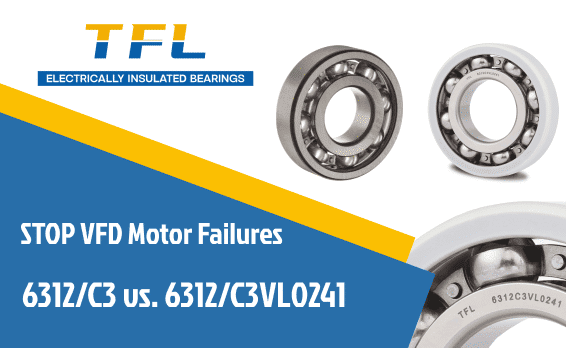


Is your VFD-driven motor failing repeatedly, even after you paid a premium for insulated bearings?
Imagine this scenario: You’ve just replaced the bearings to prevent electrical erosion. Yet, two weeks later, the diagnosis is the same: Fluting and bearing damage caused by shaft currents.
How is this possible?
The reality is that you may have fallen victim to a counterfeit insulated bearing. As the demand for Electric Vehicles (EVs) and industrial automation grows, the market is flooded with high-tech looking fakes that fail catastrophically under load.
The cost isn’t just the bearing—it’s the unplanned downtime, emergency repairs, and lost production.
At TFL, as a dedicated manufacturer of plasma-sprayed insulated bearings, we see these “look-alikes” every day. They might look identical to the naked eye, but they lack the essential dielectric properties to protect your motor.
In this guide, our engineers reveal the practical secrets to spotting a fake before it destroys your equipment. You will learn:
- The “Matte vs. Glossy” Rule: A simple visual check you can do in seconds.
- The Undercut Trap: The dimensional flaw most counterfeiters miss.
- Why your multimeter might be lying to you about insulation resistance.
- The Destructive Test: How to reveal cheap paint vs. real ceramic coating.
Don’t let a $50 fake bearing cause a $50,000 shutdown. Here is how to tell the difference.
What is a “Counterfeit” Insulated Bearing?
When we talk about counterfeits in the niche of insulated bearings, we aren’t just talking about a fake brand logo stamped on a cardboard box. We are talking about a fundamental technology scam.
A “counterfeit” insulated bearing is defined as a standard steel bearing that has been coated with low-grade non-conductive paint, epoxy, or resin, disguised to look like high-performance ceramic insulation.
To understand why these fail, you must understand how a real insulated bearing is made.
The Real Deal: Plasma Spray Technology (APS)
True insulated bearings (like those manufactured by TFL) rely on Atmospheric Plasma Spraying. We melt ceramic powder (Aluminum Oxide / Al2O3) at temperatures exceeding 10,000°C and spray it onto the bearing surface.
- The Result: A coating that forms an atomic bond with the steel. It is extremely hard, dissipates heat efficiently, and creates an impenetrable barrier against VFD currents.

The Counterfeit Method:
Unethical manufacturers often take a standard steel bearing and simply spray it with non-conductive paint, epoxy, or resin.
- The Result: It looks like an insulated bearing, but it lacks the hardness, thermal stability, and dielectric strength required to stop high-frequency VFD currents.
Comparison: Why Paint Fails Where Ceramic Succeeds
| Feature | TFL Ceramic Coating (Real) | Paint/Resin Coating (Fake) |
| Material | High-purity Aluminum Oxide (Ceramic) | Epoxy, Resin, or PPS Plastic |
| Hardness | > 650 HV (Harder than steel) | Soft (Can be scratched with a knife) |
| Bonding | Mechanically & Chemically Bonded (Won’t peel) | Weak Surface Adhesion (Peels like skin) |
| Thermal | Excellent heat dissipation | Acts like a blanket, trapping heat |
| Dielectric | Stable at high voltage (>1000V) | Breaks down/arcs instantly |
Tech Clarification: Please distinguish between Injection Molded resin (a valid technology used by brands like NTN) and Spray Painted coatings. The counterfeits we warn against are simply sprayed with non-durable paint, lacking the structural integrity of a molded layer.
4 Ways to Spot the Counterfeit Insulated Bearings
You don’t always need an electron microscope to spot a dud. In fact, most low-quality counterfeits fail basic field inspections that you can perform right at your receiving dock. Here are the four essential tests to verify authenticity.
1. Visual & Texture Check: The “Matte vs. Glossy” Rule
The easiest way to filter out 80% of cheap fakes is by looking at the finish and touching the surface.
- The Real Deal (TFL Standard):
High-quality plasma-sprayed ceramic coatings have a distinct matte finish.- The Touch Test: Run your finger over the outer ring. It should feel slightly textured, similar to unglazed pottery or very fine eggshell. This texture increases the surface area for heat dissipation.
- The Color: Typically an off-white, matte grey, or dark grey (depending on the specific oxide mix), but never shiny.
- The Fake (The “Plastic” Look):
Paint and epoxy coatings usually look glossy, shiny, or plastic-like.- The Touch Test: If it feels smooth, waxy, or slippery like a PVC pipe, it is likely paint.
- Pro Tip – Check the Chamfers (Edges): Look closely at where the coating meets the steel edge (the chamfer). A professional coating process uses precise masking tools.
- Real: Clean, sharp lines where the coating ends.
- Fake: Look for “overspray,” messy lines, or paint drips pooling at the edges.

Pro Tip: Look at the chamfers (the sloped edges). A professional coating process uses precise masking. Fakes often have messy, uneven lines or “overspray” on the rolling elements.
2. The Dimensional Trap: The Undercut Secret
This is the technical detail that separates professional manufacturers from garage workshops. It all comes down to geometry.
- The Problem with Fakes (Oversized OD):
Counterfeiters take a standard, off-the-shelf bearing and simply spray a layer of insulation on top of it.- The Result: The coating adds thickness (approx. 0.05mm – 0.2mm). This makes the Outer Diameter (OD) larger than the ISO standard tolerance.
- The Consequence: When you try to install this “fat” bearing, it won’t fit into the motor housing. If you force it, you risk cracking the housing or the coating itself.
- The TFL Process (The “Undercut” Method):
We don’t just coat a finished bearing. We remanufacture it.- Undercutting: We first grind the steel outer ring down (removing material) to make room for the insulation.
- Coating: We apply the plasma ceramic layer.
- Finish Grinding: We grind the ceramic layer back down to the precise ISO H6/j5 tolerances.
- The Test:
Take a micrometer and measure the Outer Diameter (OD).- If the bearing OD matches the standard catalog spec perfectly, it is likely Real.
- If the bearing OD is significantly larger (by +50µm or more), it is a coated standard bearing—Fake.

3. Electrical Performance: Why Your Multimeter Is Lying to You
Many buyers make the fatal mistake of testing insulated bearings with a standard handheld multimeter. They see an “Open Loop” (High Resistance) reading and assume the bearing is safe. This is a dangerous assumption.
- The “9V Trap”: A standard multimeter typically outputs only 9V from its battery.
- The Fake Reality: Even a thin layer of cheap spray paint can block 9V. Your meter will say “insulated.”
- The VFD Reality: A Variable Frequency Drive (VFD) outputs high-frequency pulses that can spike over 1000V. Under this pressure, cheap paint breaks down instantly, allowing current to pass through and destroy the raceways.
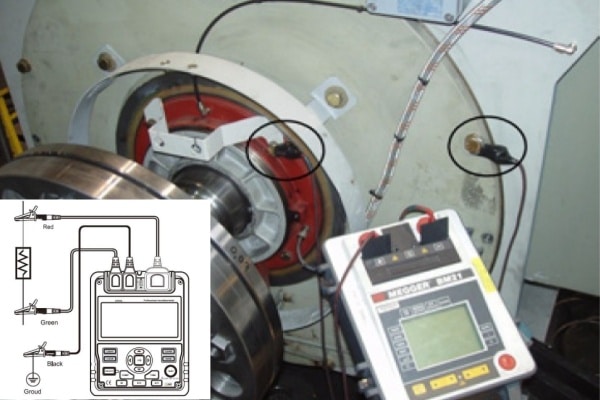
- The Only Valid Test (The Megger Test):
You must use an Insulation Resistance Tester (Megger) capable of applying high voltage.- Test Setting: Set the voltage to 500V DC or 1000V DC.
- The TFL Standard: Our ceramic coatings consistently maintain resistance > 1 GΩ (1000 MΩ) at 500V DC. Even in humid conditions, it remains > 100 MΩ.
- The Fake Result: When hit with 500V, a counterfeit coating often suffers dielectric breakdown. You will likely see the resistance drop to zero or hear the “snap” of arcing.
4. The Destructive Test: Chip vs. Peel
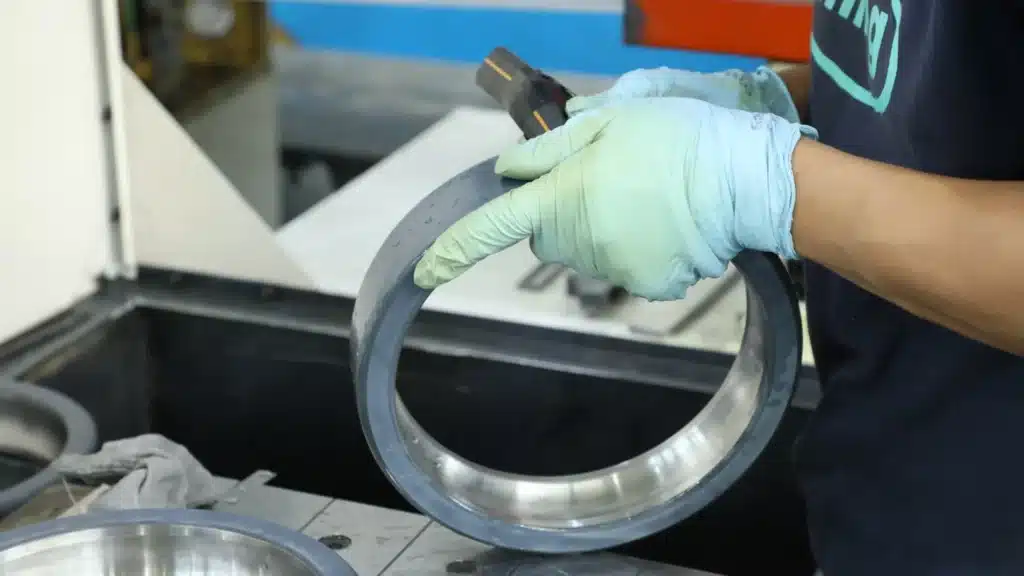
If you have a damaged bearing or a sample you are willing to sacrifice, this is the most definitive physical test. It reveals the fundamental difference between Atomic Bonding (Plasma) and Surface Adhesion (Paint).
- The Scratch/Knife Test:
Try to scratch the coating surface firmly with a pocket knife or a sharp metal object.- Real (Ceramic): The surface is harder than steel (> 650 HV). The knife should slide off, leaving perhaps a faint metal mark from the knife itself, but no deep scratch on the coating.
- Fake (Paint/Soft Resin): The knife will dig in. You can easily carve a groove or peel up a ribbon of material.
- The Hammer Test (Impact):
Strike the edge of the outer ring with a hammer.- Real (Ceramic): Ceramic is brittle and hard. If it fails, it will chip or shatter like a porcelain plate or a coffee mug. It comes off in hard, sharp shards.
- Fake (Paint): Paint is elastic. It will dent, deform, or peel off in strips like dry skin or plastic wrap.
Cost of Fakes: It’s More Than Just the Bearing Price
Why does all this matter? You might think saving 20-30% on the purchase price of a generic insulated bearing is a win for your budget. This is the “Iceberg Illusion.”
The purchase price is just the tip of the iceberg. When a fake coating fails (and it will fail), the real costs begin to mount.
- The “Blanket Effect” & Overheating:
As mentioned, paint and resin act as thermal insulators. They trap heat inside the bearing. This leads to lubricant degradation and premature mechanical failure—even before electrical damage occurs. - Return of the Shaft Voltages:
Once the thin paint layer is breached by an arc (which can happen in milliseconds), the bearing is no longer insulated. The high-frequency VFD currents resume their path to ground through the rolling elements. - The $50 vs. $50,000 Equation:
- Scenario: A $50 counterfeit bearing saves you $15 upfront.
- Reality: It fails in 3 months. Your production line stops.
- The Bill: Emergency motor rewind (
2,000)+Crane/Labor(2,000)+Crane/Labor(1,000) + 4 hours of lost production ($40,000). - Total Loss: $43,000… all to save $15.
Bottom Line: A counterfeit insulated bearing is not a cost-saving; it is a ticking time bomb inside your motor.
How TFL Ensures 100% Authenticity and Quality
At TFL, we don’t take shortcuts. We position ourselves as the reliable, high-performance alternative to the “Big Three” brands, but with faster lead times and strict quality control.
Here is how we guarantee that the bearing you receive is the real deal:
1. The APS Process (No Shortcuts)
We do not use paints or dips. We utilize advanced Atmospheric Plasma Spray (APS) robotics to bond high-purity Aluminum Oxide powder to the steel at temperatures exceeding 10,000°C. This ensures the coating is part of the bearing, not just sitting on top of it.
2. The “Pre-Grind” Protocol (Solving the Dimension Trap)
To avoid the dimensional issues found in fakes, we strictly follow a 3-step geometric process:
- Step 1: Undercut (Grind down) the base bearing.
- Step 2: Apply Ceramic Coating.
- Step 3: Finish Grind to ISO H6/j5 tolerances.
This ensures our insulated bearings fit your motor housing perfectly, every time.
3. 100% High-Voltage Testing
We don’t spot check. Every single insulated bearing that leaves our factory undergoes a 1000V DC Insulation Resistance test. If it doesn’t show >100 MΩ resistance, it goes to the scrap pile, not the shipping box.
4. Laser Traceability
Counterfeits love anonymity. TFL bearings are proud of their origin. Each bearing is laser-marked with a unique batch code. This allows us to trace the product back to the specific manufacturing date, raw material batch, and test results.
Buyer’s Guide: 3 Red Flags Before You Buy
You can often spot a scammer before the bearings even arrive at your dock. Here are three critical checks to perform during the quotation phase.
1. The “Too Good To Be True” Price Gap
High-purity Aluminum Oxide powder and plasma spray robotics are expensive. Precision grinding takes time.
- The Red Flag: If a supplier offers you an insulated bearing at a price 30-50% lower than the market average for a quality equivalent (or significantly cheaper than TFL), run away.
- The Reality: They aren’t efficient; they are using paint. You aren’t buying a bargain; you are buying a liability.
2. Demand the “1000V Test Report”
Don’t just ask for a “datasheet” (anyone can copy-paste a PDF). Ask for a specific Batch Test Report.
- The Strategy: Ask the supplier: “Do you provide a factory test report certifying 1000V DC insulation resistance for this specific batch?”
- The Reaction: A counterfeiter will hesitate, make excuses, or send a generic catalog page. A legitimate manufacturer like TFL will say, “Yes, it comes in the box.”
3. Request a Sample for the “Scratch Test”
If you are planning a bulk order, ask for one sample first.
- The Strategy: Tell them clearly: “We will perform a destructive scratch test and a 1000V Megger test on the sample.”
- The Outcome: Scammers often refuse to send samples once they know you know how to test them.
Conclusion: Don’t Let Cheap Paint Ruin Your Motor
Insulated bearings are the last line of defense for your modern VFD-driven motors. They stand between your expensive equipment and catastrophic electrical erosion.
Don’t let a layer of 20-cent paint jeopardize a $20,000 operation.
By understanding the difference between professional Plasma Spray Technology and cheap cosmetic counterfeits, you can make smarter procurement decisions. You don’t need a laboratory to protect your business—you just need the right checklist and a trusted partner.
Ready to secure your equipment with 100% verified insulated bearings?
At TFL, we are open about our process because we are proud of our quality.
- Need Proof? Contact us to request a free “Scratch Test” Sample Kit.
- Have a Project? Send us your specs for a competitive quote on Genuine Plasma-Insulated Bearings.