

Capacitance and impedance determine how easily high-frequency electrical energy from inverters and power electronics can couple into motor bearings and trigger electrical bearing failure. They control both the voltage that builds up across the lubricant film and the current that discharges through rolling contacts, so understanding them is essential for designing adequate protection, such as insulated bearings and shaft grounding.
Electrical Bearing Failure in Modern Motors
In inverter‑fed motors, the stator windings, rotor, shaft, housing, and bearings form a complex network of stray capacitances. Rapid pulse‑width‑modulated (PWM) voltage transitions create common‑mode voltage between the stator and rotor, which then charges these capacitances. When the shaft‑to‑frame voltage exceeds the dielectric strength of the lubricant film, an electrical breakdown occurs through the microscopic contact patches between rolling elements and raceways. Each breakdown acts like a tiny electric discharge machining (EDM) shot, melting pits into the steel, roughening surfaces, and eventually forming fluted grooves, increased vibration, and early bearing failure.

Under healthy conditions, the lubricant film behaves as a good dielectric, and only very small displacement currents flow. Problems start when the instantaneous shaft‑to‑frame voltage becomes large enough that the electric field across the lubricant film exceeds its dielectric strength. Local weak points-such as areas where the film is thinnest, where surface asperities are closest, or where contamination has reduced breakdown strength-are the first to fail. At these microscopic spots, the insulating film collapses, ionized gas and degraded lubricant form a conductive plasma channel, and a short, intense current pulse jumps across the contact. Each of these event’s functions like a tiny EDM impact: a minuscule amount of metal is melted and ejected from the raceway or rolling element, leaving behind a crater with resolidified, brittle edges.
Although each discharge removes only a microscopic volume of material, PWM drives can produce many thousands of voltage transitions per second. Over millions of cycles, the cumulative effect of these EDM shots transforms originally smooth raceway surfaces into a frosted texture. As damage progresses, the discharge pattern often synchronizes with mechanical resonances or cage‑passing frequencies, carving regular “washboard” fluting grooves around the raceway circumference. These grooves change the contact geometry, increase friction, and generate characteristic high‑frequency noise. The roughened surfaces also disturb the lubricant film, promoting additional heat generation and accelerating grease degradation. Eventually, the bearing exhibits elevated vibration, rising temperature, and spalling, leading to premature failure that occurs far earlier than the calculated mechanical L10 life would suggest.
Bearings as Capacitors: Where Capacitance Comes From
Electrically, a lubricated rolling bearing behaves like a small capacitor: the inner ring and rolling elements form one electrode, the outer ring forms the other, and the lubricant film is the dielectric between them. The effective bearing capacitance depends on geometry (contact area and spacing), lubricant properties (relative permittivity), and film thickness, all of which change with speed, load, and temperature.
Research shows that bearing capacitance typically decreases with increasing speed (because film thickness increases) and increases with higher load as the Hertzian contact patch enlarges. As a result, two motors running at different speeds or loads can have very different capacitive coupling behaviour, even with identical bearings and drives.
Impedance: Why High Frequencies Are So Harmful
Impedance is the total opposition to alternating current, combining resistance and reactance. For a capacitor, the magnitude of capacitive reactance is XC = 1/(2πfC), so as frequency f increases or capacitance C increases, impedance drops. In practice, this means that high-frequency components from PWM switching see the bearing path as low-impedance, even if the DC resistance is very high.
Experimental impedance measurements on running bearings show that in the “insulating state” the bearing behaves like a parallel RC element: a capacitance in parallel with a finite resistance that accounts for dielectric losses. At typical PWM switching frequencies, the capacitive branch dominates, so significant current can flow through the bearing’s capacitive path well before any breakdown, charging the lubricant film toward critical voltage levels.

From Capacitive Charging to Electrical Breakdown
When the voltage across the bearing capacitance reaches the lubricant’s breakdown field, the insulating state collapses locally and current jumps through a tiny contact area. During this “partial breakdown state,” the bearing’s impedance drops abruptly and becomes more resistive, allowing a short-lived but intense current pulse that melts small craters in the metal.
Repeated cycles of charging (capacitive) and discharging (resistive) produce:
- Frosting of raceways from many overlapping pits.
- Ripple-shaped fluting grooves as discharge repetition couples with mechanical frequencies such as cage rotation or resonance modes.
- Accelerated lubricant degradation and white-etching crack (WEC) formation under some conditions.
Simulations and lab tests confirm that the energy released in these discharges is strongly influenced by both the voltage across the bearing (set by the capacitance network) and the impedance of the discharge path.
System-Level Capacitance and Common-Mode Impedance
A motor on a VFD is not just a single bearing capacitor; it is part of a larger common-mode network that includes:
- Stator-to-rotor and stator-to-frame capacitances.
- Cable capacitance and any filter or choke elements.
- Bearing capacitances at both ends of the shaft.
The common-mode current is approximately the common-mode voltage divided by the total common-mode impedance of this network. When that impedance is low—because of high combined capacitance, poor grounding, or lack of filtering—common-mode current increases, and a portion of it tends to flow through the bearings whenever they enter a conductive or breakdown state.
Studies on electro-tribodynamic models of bearings show that changes in lubricant film thickness and contact geometry modulate the local capacitance in step with mechanical frequencies such as shaft speed, cage speed, and resonances. This explains why characteristic erosion patterns often line up with these mechanical frequencies on vibration spectra and why particular operating points (for example, certain mid-speed ranges on a VFD) can be especially damaging. Drive settings such as switching frequency, modulation method, and carrier randomization also reshape the common-mode spectrum and therefore the stress seen by bearings.
Measuring Bearing Capacitance and Impedance
To move from theory to practice, engineers increasingly measure bearing impedance and capacitance directly. Laboratory and test-rig set-ups often use small AC excitation sources and bridge circuits to inject a known signal between shaft and frame while the bearing is rotating, then record both magnitude and phase of the resulting current.
These measurements reveal several important behaviours:
- At low electric field strengths, bearings show a clear insulating RC-like behaviour, with capacitance and leakage resistance relatively stable over time.
- As applied voltage approaches the lubricant’s breakdown field, impedance becomes non-linear and intermittent discharges begin, visible as sudden drops in impedance or bursts of current.
- Shaft speed, applied frequency, and voltage amplitude all change the probability of breakdown: higher speed can reduce capacitance but may also thin or starve the film; higher frequency lowers capacitive reactance; higher voltage increases stored energy per discharge.
By combining these measurements with surface inspections and life tests, researchers have been able to correlate particular impedance signatures with specific damage mechanisms, leading to more accurate failure models and design rules for inverter-fed machines.
Mitigation: Managing Capacitance and Impedance to Protect Bearings
Because capacitance and impedance shape how and where currents flow, mitigation focuses on redistributing or limiting current paths rather than trying to remove all electrical phenomena.
Key measures include:
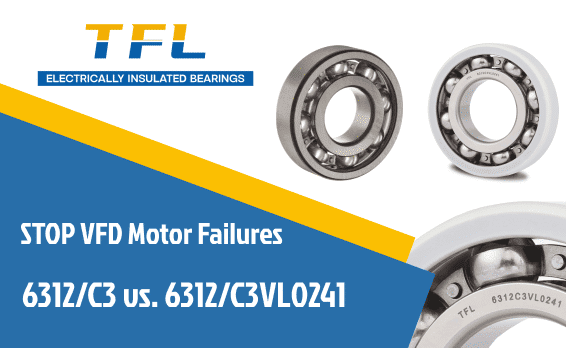
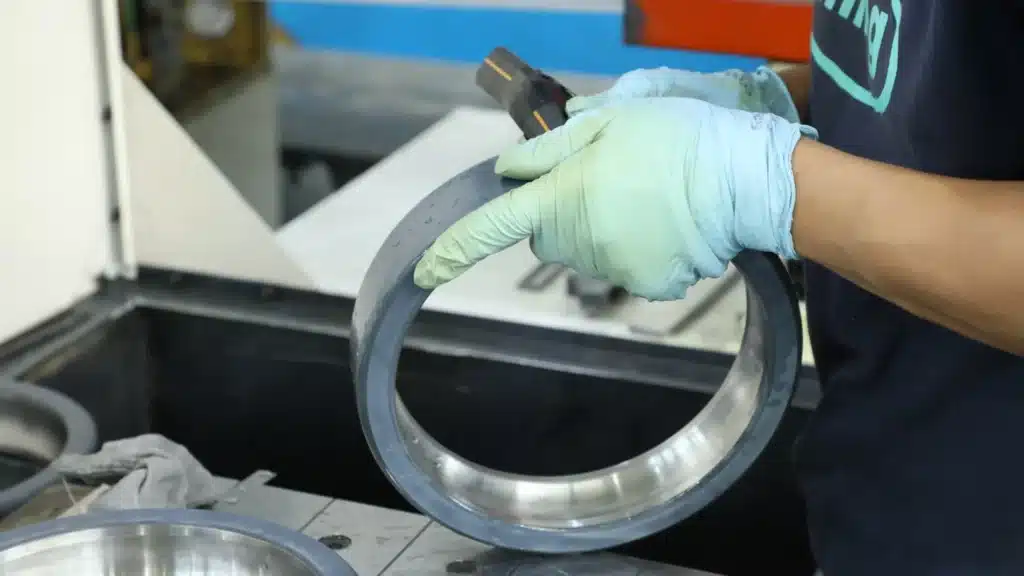
- Electrically insulated bearings: Applying a ceramic coating on one ring or using hybrid ceramic bearings greatly increases shaft-to-frame impedance at that location, effectively removing that bearing from the common-mode network and forcing currents to return via other, less harmful paths.
- Shaft grounding rings or brushes: These provide a deliberate low-impedance route from shaft to frame, reducing shaft voltage and the share of common-mode current that tries to use bearing capacitances.
- Common-mode chokes and filters: Properly designed filters increase common-mode impedance at PWM frequencies and reduce the high-frequency content at the motor terminals, cutting the energy available to charge bearing capacitors.
- Good grounding and bonding practices: Ensuring low-impedance, low-inductance connections between frames, panels, and drive returns prevents unintended “bottlenecks” that would otherwise raise shaft voltage and encourage bearing discharges.
Field experience and simulation studies agree that no single measure is perfect. The most reliable reduction in electrical bearing damage usually comes from combining insulated bearings with controlled grounding and appropriate filtering, so that both the capacitance distribution and the total common-mode impedance are favourable.
Stop Electrical Bearing Failure Before It Starts
Understanding the physics of capacitance and impedance is crucial, but implementing the right solution is what saves your equipment. At TFL Insulated Bearings, we apply this scientific knowledge to manufacture premium insulated bearings that effectively block stray currents and prevent EDM damage.
Our coatings are engineered to provide high dielectric strength, ensuring that even when system impedance drops, your bearings remain protected. Don’t let invisible electrical stresses shorten the life of your motors.
Ready to upgrade your reliability?
- Contact Us: Email our engineering team at [email protected] for technical advice.
- Call Us: Discuss your specific motor requirements at +86 15806631151.
- Get a Quote: Send us your bearing model numbers today for a fast, competitive proposal.