Precision engineering is at the heart of electric motor reliability, and nowhere is this more critical than in the world of bearing fits and tolerances. Bearings are the silent heroes that support rotating shafts, enable high efficiency, minimize wear, and maximize equipment uptime. But perfect bearing performance is not just about selecting the right bearing type or material; it requires meticulous attention to fits and tolerances between bearings, shafts, and housings. Errors in these details can lead to noise, vibration, failures, and massive maintenance costs. This guide goes deep into the science and practice of bearing fits and tolerances for electric motors, arming engineers, maintenance leaders, and technical buyers with strategies, tables, and best practices for longer-lasting, trouble-free motor operation.
Summary Table Fits & Tolerance Quick Guide
| Fit Type | Shaft/Housing | Motor Application | Key Risk if Wrong |
| Clearance | H7/h6, H8/g6 | Small/light duty | Spinning, vibration |
| Transition | k6/m6, J7 | Medium duty, easy removal | Creep, noise |
| Interference | n6/p7, N7/P7 | High load/high RPM | Brinelling, overheating |
| Precision Grade | P6/P5/P4 | High-speed, sensitive | Accuracy/vibration |
| Internal Clearance | CN/C3/C4 | All types | Noise, friction |
The Science of Bearing Fits & Tolerances
What Is a Bearing Fit?
Understanding the science behind bearing fits and tolerances is fundamental to achieving reliable and long-lasting electric motor performance. “Fit” refers to how tightly or loosely a bearing is mounted on a shaft or within a housing, while “tolerances” describe the permissible variations in the dimensions of these parts. Together, these factors govern the mechanical interaction between the bearing and its mating components, influencing everything from vibration and noise to heat generation and wear.
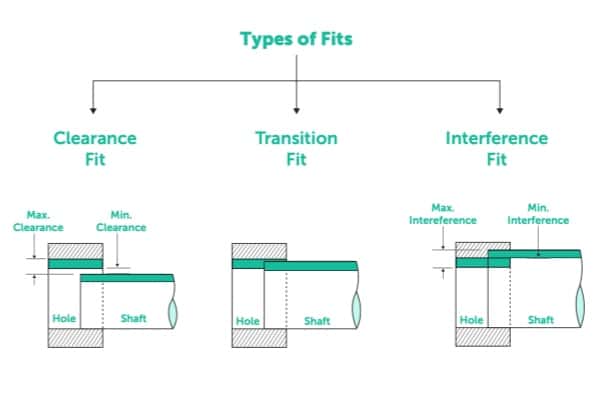
Bearing Fit Types: Clearance, Transition, and Interference
- Clearance Fit:
This type of fit provides a gap between the bearing and shaft or housing, allowing the bearing to move slightly or be easily installed and removed. While easy to assemble and disassemble, excessive clearance can lead to bearing movement or “creep,” causing fretting corrosion, wear, and loss of alignment. Clearance fits are typically used in applications with lower loads or where frequent maintenance is necessary.
- Transition Fit:
A compromise design, transition fits offer a minor interference or clearance zone where the bearing may require light pressing for installation. These fit balances ease of assembly with some resistance to bearing movement, making it suitable for many standard industrial motors.
- Interference Fit:
This fit requires pressing or thermal expansion to mount the bearing tightly on the shaft or housing, eliminating relative motion between parts. It provides excellent positional stability for high-load, high-speed, or vibration-prone motors. Still, it demands precise machining and careful installation, as excessive interference can lead to high stress, heat, and premature failure.
The Role of Tolerances
Tolerances specify the allowable deviations in component dimensions to ensure consistent fits across production batches and operation conditions. These are defined by international standards such as ISO, ANSI, and JIS.
- Precise tolerances accommodate thermal expansion of shafts and housings during operation, preventing loosening or over-tightening as parts heat up or cool down.
- They control roundness, surface finish, and dimensional accuracy, critical for minimizing vibration and noise.
- Tight tolerances (e.g., precision grades P5, P4) are used in high-speed or ultra-quiet motors, while general-purpose motors use less stringent classes (P0, P6).
Effects of Fits and Tolerances on Motor Operation
- Incorrect fits can cause bearing creep, fretting corrosion, increased friction, heat buildup, and eventual bearing failure.
- Tight fits may cause metal deformation or brinelling-denting from excessive pressure, leading to early fatigue.
- Optimal fits ensure correct load transfer, stable shaft alignment, minimal vibration, and easy maintenance without damaging components.
Engineering Considerations
The selection of fit and tolerance must consider:
- Load direction and magnitude: Rotating rings need tighter fits; higher loads demand greater interference.
- Operating speed: High RPM applications require precise, stable fits with appropriate clearances to avoid heat and noise.
- Thermal effects: Aluminum housings expand differently from steel shafts, requiring adjusted fits.
- Maintenance needs: Equipment requiring disassembly benefits from looser fits, while permanent installations favor interference.
Practical Measurement and Installation
- Use calibrated micrometers, bore gauges, and precision instruments for fit verification.
- Bearings should be mounted using professional techniques like induction heating or hydraulic pressing to avoid damage.
- Thorough cleaning and deburring of shafts and housings prevent tolerance deviations from dirt or mechanical damage.
Why Fits & Tolerances Matter
Poor fit can sabotage motor performance in countless ways:
- Loose fits: Bearing movement, raceway spinning, fretting corrosion, shaft wear, alignment loss.
- Tight fits: Excessive preload, high friction, heat buildup, risk of brinelling, and early failure.
- Wrong tolerances: Unpredicted shaft/housing movement, compromised precision, noise, vibration, or rapid bearing wear.
Correct fit leads to:
- Reliable shaft alignment
- Efficient loading and force transfer
- Easy maintenance and repeatability
- Vibration minimization
- Extended bearing life and motor reliability
Types of Fits Used in Electric Motors
Clearance Fit
- Allows easy movement, quick disassembly.
- Used where low load and frequent replacement are expected.
- Example: Housing fit H7, shaft fit g6 or h6.
Transition Fit
- Small interference; requires light force to mount.
- Balances easy installation and some resistance to movement.
- Example: Shaft fit k6, housing fit J7.
Interference Fit (Press Fit)
- Requires thermal expansion or substantial force for assembly.
- Used on high-load, high-speed, or vibration-prone motors.
- Typical for the rotating ring under load (shaft-turning inner ring): Shaft fit m6, n6, p6; Housing fit N7, P7.
Tolerance Grades & International Standards
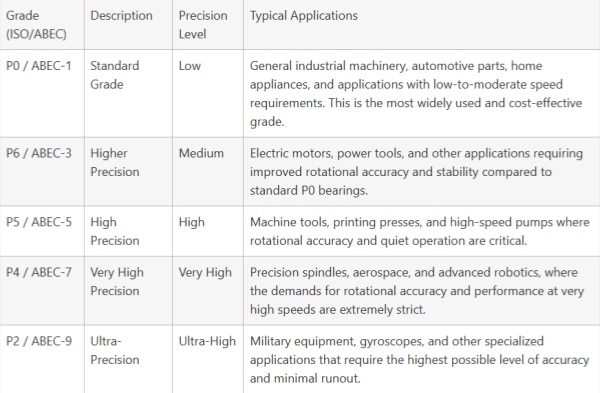
Common precision/tolerance grades include:
| Grade | ISO | ABEC | Typical Use |
| Normal | P0 | 1 | General duty motors |
| Precision | P6, P5 | 3, 5 | Industrial motors |
| High | P4 | 7 | High-speed spindles |
| Ultra | P2 | 9 | Critical aerospace, servo |
Precision affects rotational accuracy, vibration, and noise-choose tighter grades for higher speeds or ultra-quiet operation.
Bearing Internal Clearance
Correct internal clearance (C2, CN, C3, C4, etc.) lets rolling elements rotate smoothly:
- C2: Less than normal for loose fits, cooler environments.
- CN: Normal-most industrial applications.
- C3, C4: Greater than normal-for interference fits, hot or high-load operation.
Clearance must compensate for fit-induced compression and thermal expansion. If a tight fit shrinks the inner ring, increase clearance; if a loose fit, normal clearance suffices.

Practical Fit & Tolerance Selection Criteria
- Load Direction: Rotating vs. stationary ring under load matters-rotating rings need tighter fits to prevent creep.
- Load Magnitude: Higher loads require tighter interference.
- Speed: High RPM motors need precision fits and stable tolerances.
- Thermal Effects: Fits must accommodate shaft/housing expansion.
- Material: Aluminum housings need looser fits than steel (greater thermal growth).
- Maintenance Needs: Easy disassembly means looser/transition fits; permanent installations favor interference.
Refer to manufacturer tables or ISO/ANSI charts for each application and size.
Table Electric Motor Bearing Fits and Tolerances
| Motor Type | Shaft Fit | Housing Fit | Precision | Clearance | Note |
| Small (up to 50mm) | k5-m6 | H6 | P0/P6 | CN/C3 | Most standard AC/DC motors |
| Medium (50-100mm) | m6-n6 | N7-P7 | P6/P5 | C3/C4 | Increased RPM/loads |
| Large (>100mm) | n6-p7 | P7-M7 | P5/P4 | C3 | High load/high vibration |
| Aluminum housing | g6/h6 | J7-H7 | P6 | C3/C4 | Adjust for expansion |
| High-speed spindle | n6/p6 | N7-P7 | P4/P2 | C3 | Ultra-precision |
Installation Methods and Considerations
- Cold Press: Best for bearings under 100mm, light transitions.
- Heating: Induction heaters for interference fits-typically heat bearings to 80-120°C, never above 150°C.
- Hydraulic Press: For large or press fits.
- Dry & Clean Components: Dirt or burrs can ruin fit; always thoroughly clean before assembly.
Use calibrated bore gauges and micrometers to verify tolerances before installation.
How Fits and Tolerances Affect Performance and Life
Failure Modes from Bad Fits
- Loose fit: Bearing rotation in seat (creep/fire), fretting, vibration, rapid wear.
- Excessive tightness: High friction, brinelling, heat, early fatigue.
- Incorrect clearances/tolerances: Loss of running accuracy, noise, imbalance.
Best Practice Prevention
- Follow manufacturer fit and tolerance charts for every bearing type.
- Adjust for real-world influences-thermal growth, material differences, mounting or removal needs.
- Use precision tools for measurement and installation.
- Audit fits/tolerances upon overhaul, and correct any out-of-spec deviations.
Troubleshooting Fit Issues
Symptoms of Fit Problems
- Bearing race discoloration/spinning marks
- Excessive noise and vibration
- Creeping out of the seat
- Shaft or housing scoring
Solutions
- Re-machine out-of-spec shafts/housings
- Use correct fit and precision grade
- Switch clearance class (C3, C4) if operation is consistently hot/high-load
Case Studies
Case 1:
A textile plant experienced frequent bearing spin in AC motors. Investigation showed undersized housing bores with a clearance fit instead of the specified class. Resizing to a k6 shaft, H7 housing fit resolved the problem.
Case 2:
A high-speed CNC spindle overheated until fit was changed from transition to interference and clearance increased from CN to C3, allowing for thermal expansion without excessive preload.
Quality Control and Advanced Practices
- Document all fit, tolerance, and clearance selections per motor/installation.
- Use laser alignment and balancing for critical fits.
- Specify bearing seat surface finish per manufacturer guidelines (typically Ra <0.4µm).
- Consider material and geometry for thermal compensation.
Work closely with bearing suppliers to ensure optimal specifications and installation support.
Conclusion
Bearing fits and tolerances are the hidden cornerstone of electric motor success. They transform good bearings into excellent outcomes, ensuring precision, reliability, and long service life. A smart, proactive approach-correct selection, meticulous installation, diligent measurement, and efficient troubleshooting- will safeguard every motor against premature failure and allow every operation to find its peak. Mastering bearing fits and tolerances is an engineer’s essential skill and a plant manager’s insurance policy for smooth, productive machinery.
Maximize Your Motor Precision with TFL Insulated Bearings
At TFL Insulated Bearings, we understand that achieving the perfect fit is only half the battle. While proper tolerances ensure mechanical stability, electrical discharge is another invisible enemy that can ruin even the most perfectly fitted bearing. We combine precision engineering with advanced insulation technology to protect your motors from both mechanical wear and stray currents.
Don’t let fit errors or electrical erosion compromise your operations. Whether you need advice on selecting the right tolerance class for your application or need high-performance insulated bearings that last, we are here to help.
Ready to upgrade your motor reliability?
- Contact us today for a custom consultation.
- Get a Quote for your specific bearing requirements.
Email us: info@sdtflbearing.com
Call us: +86 15806631151