

The performance and lifespan of motor bearings are determined primarily by operating temperature, applied load, and rotational speed-the “trinity” of bearing engineering. Each of these factors interplays with lubrication, design, and maintenance, dictating whether your motor delivers reliable uptime or succumbs to unexpected breakdowns, rapid wear, and costly repairs.
This comprehensive technical guide explores the science and practical realities behind these three forces, explains their impact on motor bearing longevity and reliability, provides case studies and actionable strategies, and explains best-practice solutions for design engineers, maintenance leaders, and operators looking to maximize bearing life in any demanding application.
Understanding Motor Bearing Fundamentals
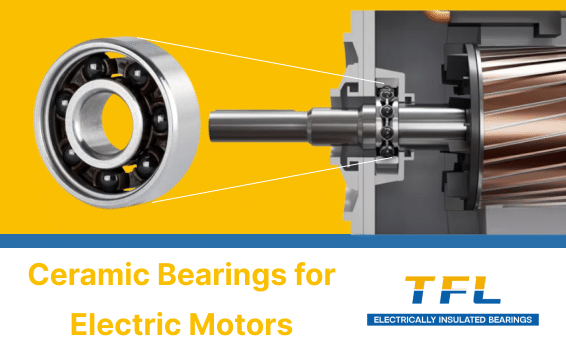
Motor bearings are among the most critical and precisely engineered components in electric motors, enabling them to deliver reliable, efficient rotary motion across a wide range of loads and conditions. These bearings serve as mechanical interfaces, supporting the motor’s rotating shaft while preventing direct metal-to-metal contact with the stationary housing, thereby drastically reducing friction and wear.
Key functions include:
- Carrying Radial and Axial Loads: Motor bearings support both forces perpendicular (radial) and parallel (axial) to the shaft, depending on the application and bearing type. This ensures smooth load transfer from the rotor to the motor housing and protects other drivetrain components from overload.
- Minimizing Friction: Through the use of rolling elements (balls or rollers) or specially engineered sliding surfaces, bearings allow the shaft to rotate with minimal resistance-cutting down energy losses, heat generation, and component wear.
- Maintaining Shaft Alignment: Precision manufacturing tolerances in the bearing design keep the motor shaft centered within tight limits, preventing unwanted vibration, uneven rotor-stator air gaps, and performance degradation.
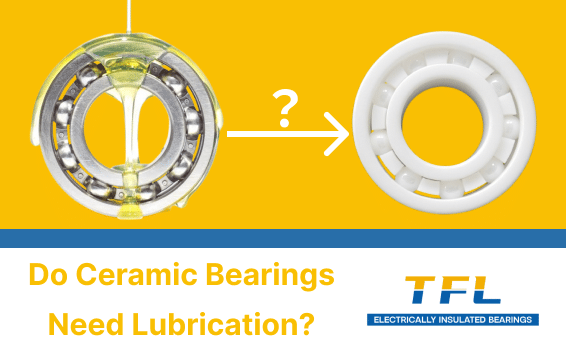
- Providing Lubrication Retention: Bearings contain and channel lubricants (oils or greases), which create the necessary film to separate surfaces, absorb contaminants, and dissipate heat, even under high loads and speeds.
- Absorbing Vibrations: The design and internal clearance of bearings help dampen shocks or oscillating forces, reducing transmission of vibration to the rest of the motor or connected equipment.
- Enduring Challenging Conditions: Bearings are engineered to operate through temperature cycling, variable loads, environmental contaminants, and high-speed operation, making reliability in strict settings possible.
Ultimately, their actual performance and lifespan depend on more than their inherent design-they also require correct selection for the application, precise installation, appropriate lubrication, regular maintenance, and careful control of external factors like temperature, load, and speed. Any failure to optimize these factors may drastically reduce bearing life, increase maintenance costs, and risk sudden downtime in critical equipment.
Temperature: The Silent Performance Killer
The Science
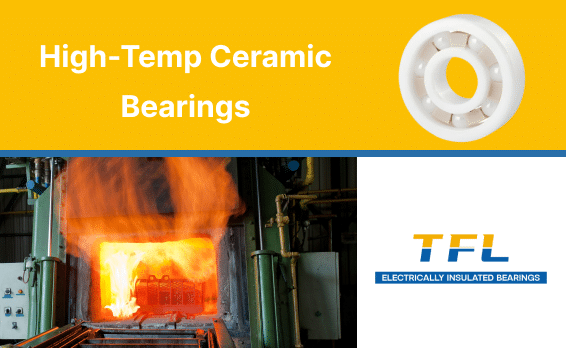
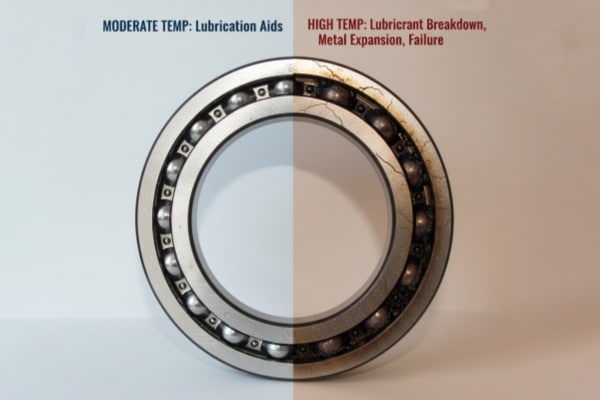
Heat is both a byproduct and an influencer of bearing operation. As rolling elements move across raceways, friction generates heat. At moderate temperatures, this aids lubrication; at high temperatures, the lubricant breaks down, the metal expands, and bearing failure accelerates.
- Normal Range for Electric Motor Bearings: 160°F-230°F (71°C-110°C).
- Critical Threshold: Bearings above 180°F (82°C) risk rapid lubricant degradation and accelerated wear.
Key Effects of High Temperatures
- Accelerated Lubricant Oxidation: Causes grease/oil to harden, crack, or escape—leaving surfaces exposed.
- Reduced Lubricant Viscosity: Oil becomes thinner, offering less protection, especially under load.
- Thermal Expansion: Raceways, balls, and cages expand, possibly eliminating necessary internal clearance and causing metal-to-metal contact.
- Seal Deformation and Failure: High heat warps seals, inviting contamination or lubricant loss.
Solutions
- Monitor and Control Temperature: Use IR sensors or thermal imaging cameras; never let operating temperatures exceed design limits.
- Use High-Temperature Lubricants: Synthetic greases/oils with stable additives for extreme heat zones.
- Employ Climate Control: Fans, heat sinks, cooling systems, and improved ventilation are vital for enclosed or high-speed applications.
- Reduce Bearing Temperature Intervals: Increase the frequency of lubrication as temperature rises.
Load: Bearing Capacity, Fatigue, and Longevity
The Science
Every bearing is rated for a dynamic (moving) and static (shock) load. Exceeding these ratings, even briefly, quickly leads to:
- Material fatigue
- Surface pitting/spalling
- Flaking, micro-cracking
- Excessive heat due to friction
Types of Loads
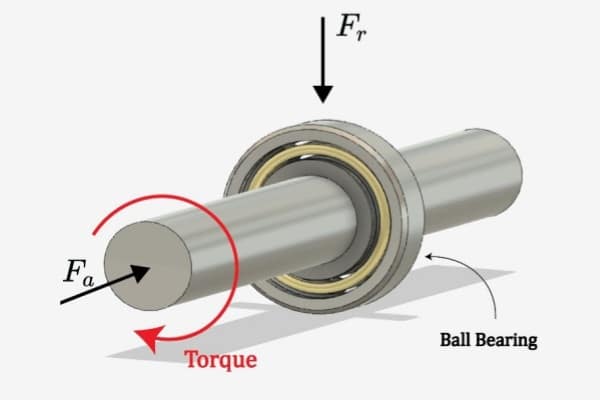
- Radial Load: Perpendicular forces-core for most motor bearings.
- Axial (Thrust) Load: Parallel forces-more prevalent in vertical motors, thrust mechanisms.
- Combined Loads: Many industrial applications impose both.
Effects on Performance
- Every increase in applied load exponentially reduces calculated bearing life:
, where C is capacity, and P is applied load.
- High loads can crush lubricating films, cause surface deformation, and force metal-to-metal contact, all accelerating wear.
Solutions
- Proper Bearing Sizing: Use accurate calculations for dynamic and static loads-never guess or fudge safety margins.
- Load Reductions: Address root causes (misalignment, process spikes, shock), avoid oversize pulleys/couplings, and optimize motor drive systems.
- Design Choices: For heavy radial loads, select cylindrical or spherical roller bearings. For combined loads or tilting shafts, consider tapered or angular contact designs.
- Periodic Load Verification: Use strain gauges, smart sensors, and trending data to spot load increases before damage occurs.
Speed: Friction, Wear, and Centrifugal Forces
The Science
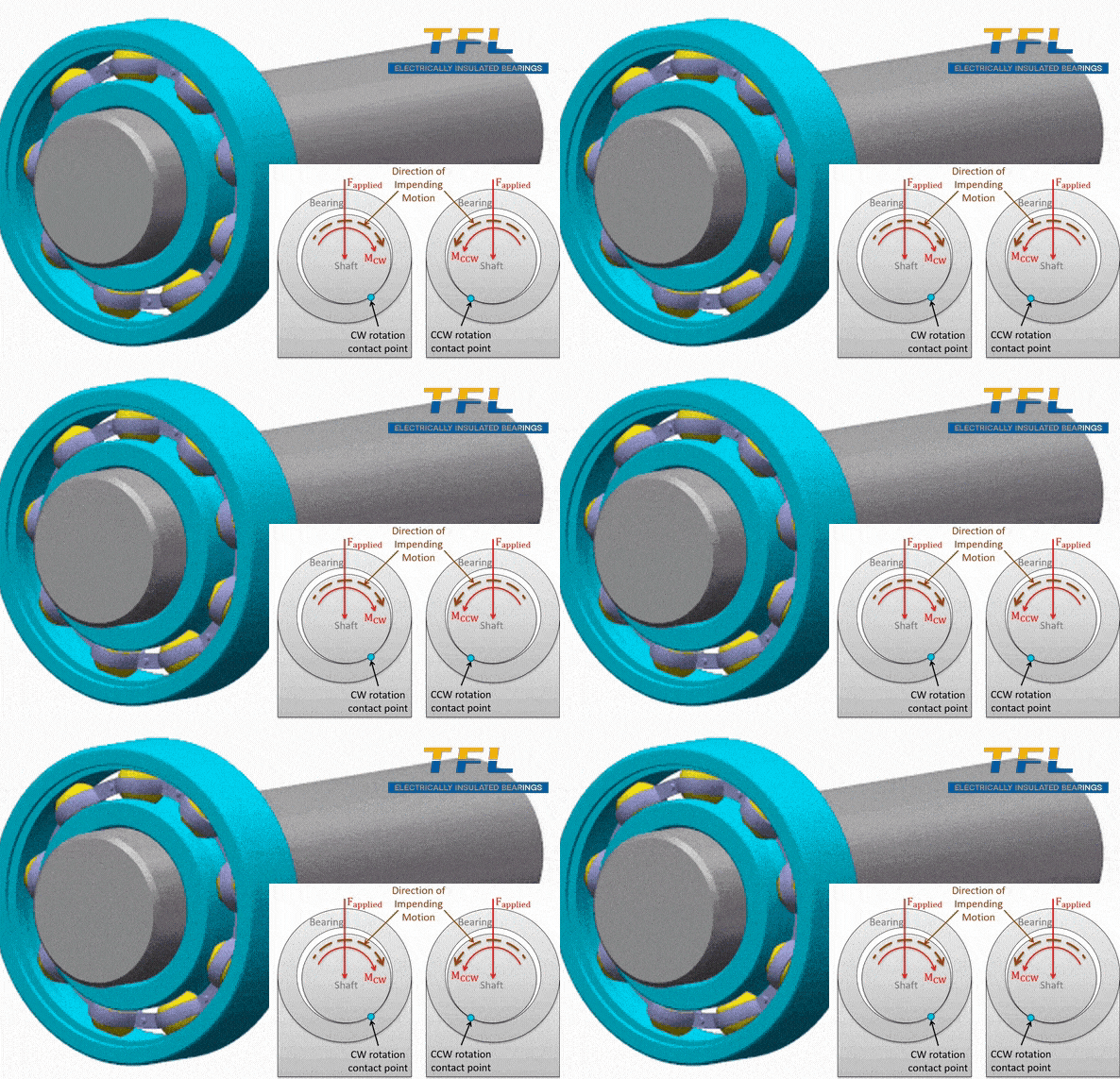
Speed (RPM or angular velocity) directly affects friction, heat generation, lubricant film stability, and the risk of bearing instability.
- High-Speed Bearing Risks: Centrifugal forces grow, pushing rolling elements outward, challenging cage control, and raising heat.
- Lubrication Breakdown: Extreme speed can cause the lubricant film to thin or scatter, exposing surfaces to boundary lubrication and wear.
Speed Capacity
- Limiting Speed: Each bearing has a manufacturer-rated maximum speed; running above this will drastically cut service life.
- High speeds also multiply vibration, requiring precision balancing and mounting.
Solutions
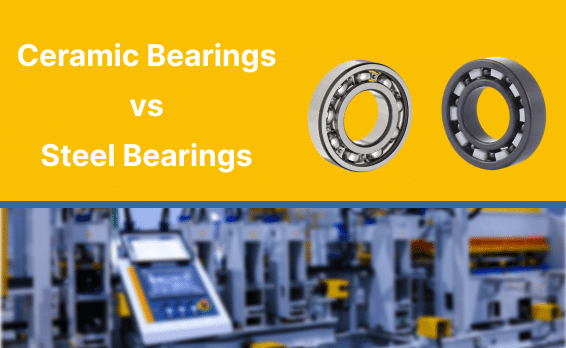
- Use Suitable Bearing Types: Deep groove ball, angular contact, and hybrid/ceramic bearings excel at high speeds.
- Maintain Proper Lubrication: Lower viscosity oils/grease for ultra-high speeds; circulating oil systems for cooling.
- Precision Assembly: Impeccable alignment, balancing, and fitment avoid vibration and instability.
- Monitor Speed and Vibration: Install tachometers and vibration sensors to spot out-of-tolerance operation.
Combined and Cascading Effects
All three factors-temperature, load, speed-combine and interact. High-speed running increases temperature; high load increases both friction and heat. Inadequate cooling, lubrication, or overspeed undermines every aspect of bearing performance.
- Bearing lifespan drops exponentially as any factor exceeds recommended ranges.
- Design trade-offs: High-speed bearings often handle lower loads, while heavy-load bearings may be limited to moderate speeds.
- Internal clearance and fit must adapt to ambient conditions and expected operating changes.
Lubrication and Its Relationship with Temperature, Load & Speed
Proper lubrication is the “glue” that ties all three factors together:
- At high speeds or loads: Use synthetic lubricants with robust film strength.
- At high temperatures: Choose lubricants with stable viscosity and oxidation resistance.
- Overfilled bearings heat up due to churning; underfilled bearings run hot due to friction.
SKF, NSK, and ABB provide industry-standard formulas to guide recommended fill percentages (often 25-35% of the available bearing housing).
Thermal Management and Monitoring
Guidelines
- Install temperature and vibration sensors for critical motors.
- Set alarm thresholds: Normal running <180°F (82°C), alarm at 200°F (93°C), and trip at 220°F (104°C).
- IR imaging for periodic checks; adjust lubrication intervals if heat rises.
Practical Troubleshooting Strategies
- If a bearing is running hot, check for over-lubrication, misalignment, excessive load, and insufficient cooling.
- For rapid wear, examine load distribution, surface contact, and lubricant longevity.
- At high speeds, monitor for cage wear, noise, and vibration spikes.
Tip: Reducing any factor (speed, load, or temperature) by even 10-20% can triple bearing life according to L10 calculations.
Case Studies
- Wind Turbine Bearings: Extreme loads and variable speeds; success achieved by selecting spherical roller bearings with high radial capacity, synthetic lubricants, and active cooling systems.
- Precision CNC Spindle: Operating at 30,000 RPM; hybrid ceramic angular contact bearings, continuous oil mist lubrication, and active climate control maintain low temperature and vibration.
- Mining Pump Motors: High static loads, moderate speed, dirty environment; sealed spherical roller bearings, grease purging, regular temperature and vibration analytics.
Table: Temperature, Load & Speed-Effects, Risks, and Solutions
| Parameter | Effect on Bearing | Common Issues | Best-Practice Solutions |
| Temperature | Lubricant breakdown, expansion, wear | Overheating, seal failure | Sensors, cooling fans, and synthetic lubes |
| Load | Fatigue, deformation, and friction | Cracking, spalling, rapid erosion | Sizing, load reduction, fit monitoring |
| Speed | Friction, instability, film scatter | Heat, vibration, cage wear | Low-viscosity lubricants, precision alignment |
Design and Maintenance Recommendations
- Select bearings for realistic load and speed profiles, not just peak ratings.
- Use high-quality lubricants, seals, and cooling systems.
- Monitor motor temperature, vibration, and speed with IoT sensors.
- Adjust maintenance protocols as ambient and process conditions change.
- Educate teams to recognize rising temperature, load spikes, and overspeed as “first-responder” warning signs.
Motor bearing performance and service life depend on a careful balancing act among temperature, load, and speed. Managing these parameters, alongside careful lubrication selection and precision engineering, empowers plant managers and engineers to push the boundaries of motor capability without risking catastrophic failure or downtime. Intelligent monitoring, predictive analytics, and tailored maintenance routines transform your bearing strategy from reactive to proactive, unlocking longer life, lower costs, and the most reliable motors in your industry.
Take the next step toward total motor protection
At TFL Insulated Bearings, we understand that mastering the trinity of temperature, load, and speed is only the beginning. To truly safeguard your critical rotating equipment, you need components engineered to withstand not only physical stressors but also the electrical challenges of modern motor applications. We specialize in manufacturing high-performance insulated bearings designed to prevent electrical erosion, minimize friction, and endure the harshest operating environments.
Don’t leave your motor’s lifespan to chance. Whether you need a custom solution for high-speed spindles or heavy-duty bearings for variable load applications, our engineering team is ready to help you extend maintenance intervals and eliminate unexpected downtime.
- Reach out to our experts for a technical consultation on your specific application.
- Request a competitive quote for your next project.
- Email us directly at [email protected] to discuss your requirements.
- Call us at +86 15806631151 for immediate assistance.
Let us help you turn bearing engineering into your competitive advantage.