

Electrically insulated bearings are becoming a critical reliability component in modern EV motors. They block damaging shaft currents created by high-voltage battery systems and inverters, preventing pitting, fluting, and premature bearing failure. This blog explains how electrical damage occurs in EV traction motors, what makes insulated bearings different, and how they reduce failures, noise, and lifecycle cost for OEMs and fleet operators.
Why EV Motors Are Hard on Bearings
High Voltages, Inverters, and Shaft Currents
High-frequency inverters almost always feed EV traction motors. Rapid switching (high dv/dt), long cable runs, and high DC bus voltages generate common-mode voltages on the rotor. When this shaft voltage exceeds the breakdown strength of the lubricant film in the bearings, micro-arcs discharge through the rolling elements and raceways. Over time, these discharges cause electrical erosion, including pitting, fluting, and surface cracking.
Duty Cycles Unique to EVs
Unlike many industrial motors that run near steady state, EV motors:
- Accelerate and decelerate frequently.
- Operate over a wide speed range, from crawl to tens of thousands of rpm.
- See frequent torque reversals due to regenerative braking.
These conditions raise electrical and mechanical stress on the bearings, making them more vulnerable to electrical erosion if not protected.
What Are Electrically Insulated Bearings?
Construction and Insulation Methods
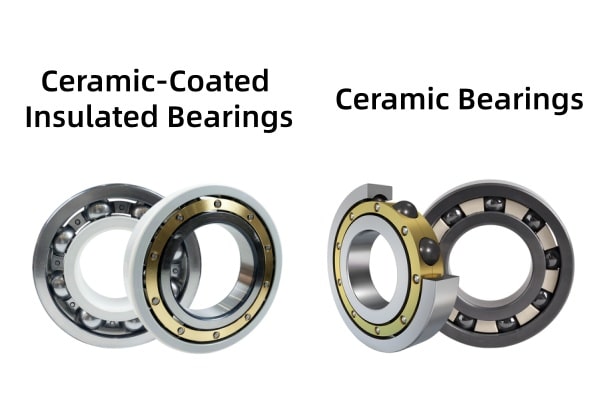
Electrically insulated bearings start with standard steel rolling bearings but add a high resistance barrier that interrupts current flow through the bearing. Common designs include:
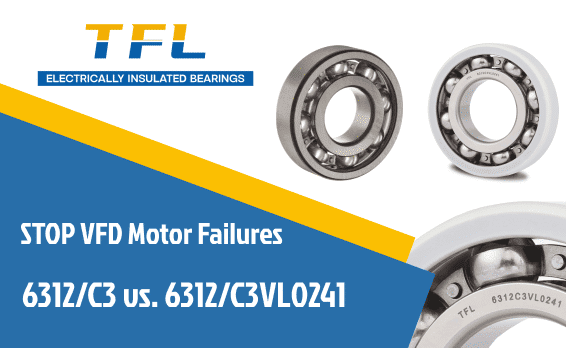
- Ceramic-coated rings: A plasma-sprayed aluminum-oxide coating is applied to the outer ring (or sometimes inner ring). This coating provides very high resistance and can withstand hundreds or even thousands of volts.
- Hybrid bearings: Steel rings with ceramic rolling elements (typically silicon nitride). The non-conductive balls block the main current path and reduce mass for high-speed operation.
Both approaches aim to keep shaft currents from using the bearing as a path to ground, while preserving standard dimensions, load ratings, and installation practices.
Electrical and Mechanical Properties
Well-designed insulated bearings typically offer:
- Insulation resistance in the megaohm range.
- Voltage withstand levels sufficient for EV inverter environments.
- Similar or improved fatigue life compared with all steel equivalents.
- Compatibility with standard lubricants and fits when EV-specific guidelines are followed.
How Electrical Damage Appears in EV Bearings
Electrical Pitting and Fluting
When unprotected bearings carry current, the first visible damage stage is electrical pitting, tiny craters where arcs have melted and re-solidified the steel. As the damage accumulates and couples with vibration, these pits align into washboard-like grooves known as fluting. In an EV motor, this leads to:
- High-pitched whining or growling noises that change with speed.
- Increased vibration transmitted into the cabin or chassis.
- Rapidly escalating wear and unexpected bearing seizure.

Lubricant Degradation and Heat
Electrical arcing locally overheats the contact zone and carbonizes grease, lowering its dielectric strength and viscosity. The bearing then runs hotter, accelerating both mechanical wear and further electrical erosion. In a compact EV motor with tight packaging, any extra heat is especially unwelcome.
Why Electrically Insulated Bearings Reduce Failures in EV Motors
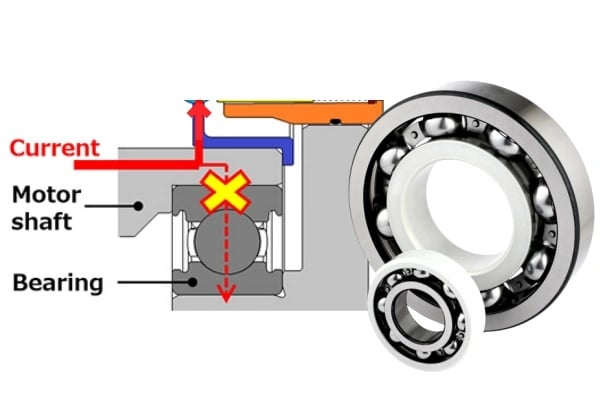
Breaking the Current Path
Insulated bearings eliminate the primary conduction path through the rolling contact zone. With a ceramic-coated ring or ceramic rolling elements, the shaft current cannot close its circuit through the bearing. Instead, it is forced to use designed return paths-such as dedicated grounding brushes, filters, or shielded cabling-where it does not harm.
Protecting Raceways and Extending Life
By blocking EDM events, insulated bearings:
- Prevent pitting and fluting.
- Keep surfaces smooth and contact pressures predictable.
- Maintain lubricant integrity for longer intervals.
In many inverter-driven applications, this can multiply bearing life several-fold compared with unprotected steel bearings, turning a frequent failure point into a long-life component.
Reducing NVH (Noise, Vibration, Harshness)
EV customers are susceptible to noise because there is no combustion engine to mask drivetrain sounds. Fluted bearings produce a tonal, speed-dependent whine that is easily heard in a quiet cabin. Preventing electrical erosion keeps bearings quiet, directly supporting OEM NVH targets.
Design Considerations for EV Applications
Choosing Between Coated and Hybrid Bearings
When specifying insulated bearings for EV motors, engineers typically weigh:
- Voltage level and waveform: Higher common mode voltages favour ceramic-coated rings with very high insulation resistance.
- Speed and acceleration: High speeds and rapid transients may benefit from hybrid bearings with lightweight ceramic balls to reduce centrifugal forces.
- Cost and volume: Coated bearings often offer a good balance of insulation performance and cost for volume production.
Many EV traction motors use a combination approach: for example, a coated bearing at one end and a hybrid or conventional bearing with dedicated grounding at the other, depending on the electrical design.
Fits, Clearances, and Thermal Behavior
EV motors often operate at high speeds and elevated temperatures. For insulated bearings, this means:
- Selecting appropriate internal clearance (such as C3/C4) to accommodate thermal expansion and interference fits.
- Ensuring that coating thickness and ring geometry are compatible with the required fits on the shaft and housing.
- Paying special attention to rotor dynamic behavior, since lightweight ceramic rolling elements change system dynamics.
Integration with the EV Powertrain System
Working with Inverter and EMC Design
Insulated bearings are most effective when treated as part of the complete electrical system:
- Inverter filtering and modulation strategies influence the actual shaft voltage waveform.
- Cable shielding, routing, and bonding affect capacitive coupling and common-mode currents.
- Grounding schemes determine where residual currents flow when they are blocked at the bearing.
Co-design between motor, inverter, and bearing suppliers helps achieve the best balance of protection, cost, and efficiency.
Complementary Protective Measures
Even with insulated bearings, EV designers commonly add:
- Shaft grounding or bonding elements on selected locations.
- Common-mode chokes or filters in the inverter output stage.
- Careful PCB and busbar layout to minimize stray capacitances and resonances.
These measures reduce electrical stress on all components, including bearings, insulation systems, and power electronics.
Maintenance and Diagnostics in EV Fleets
Condition Monitoring Opportunities
While EV drivetrain bearings are designed for long life with little maintenance, fleet operators and OEMs still benefit from:
- Vibration and acoustic analysis to detect early anomalies.
- Temperature and current monitoring in critical prototypes or high-duty vehicles.
- Teardown inspections of test motors to confirm that insulated bearings are preventing electrical erosion as intended.
Early field data helps refine bearing selection, lubrication, and inverter control strategies.
Failure Modes When Protection Is Missing
Where insulated bearings or proper grounding are not used, typical field issues include:
- Premature bearing noise and vibration leading to warranty claims.
- Unexpected traction motor failures that immobilize vehicles.
- Customer dissatisfaction from tonal whining under certain speeds or loads.
Retrofitting insulated bearings and improving the electrical design are often the most direct corrective actions.
Cost and Reliability Benefits for EV Manufacturers
Lower Warranty and Recall Risk
Traction motor replacement is one of the costliest warranty events for an EV manufacturer. By eliminating a primary failure mechanism, electrical bearing erosion, insulated bearing:
- Reduce the likelihood of early motor replacements.
- Support more extended drivetrain warranty periods.
- Improve perceived quality and brand reliability.
Total Cost of Ownership for Fleets
For commercial EV fleets such as buses, delivery vans, and heavy-duty trucks, downtime is expensive. Insulated bearings help fleets:
- Avoid unexpected traction motor outages.
- Extend maintenance intervals.
- Maintain consistent performance over high mileage.
When considered over the vehicle lifecycle, the incremental cost of insulated bearings is typically outweighed by savings in repairs and lost operating time.
Practical Specification Tips for EV Projects
When Electrically Insulated Bearings Are Strongly Recommended
- Traction motors driven by high voltage inverters with high switching frequencies.
- Motors with long cable runs between the inverter and the stator.
- Platforms targeting extended warranties or high mileage (taxis, buses, logistics fleets).
- Designs where NVH targets are strict and bearing-induced whine is unacceptable.
Questions to Ask Bearing and Motor Suppliers
- What insulation resistance and voltage withstand does the bearing provide?
- Which ring is coated, and how does that affect fits and clearances?
- Are hybrid (ceramic ball) versions available, and when are they recommended?
- What lubrication and maintenance guidelines apply specifically to insulated designs?
- Are there test results or case studies for similar EV duty cycles?
Having these answers early keeps the program on track and avoids late redesigns.
Secure Your EV Drivetrain Reliability with TFL Insulated Bearings
As the electric vehicle market demands higher efficiency and longer service intervals, preventing premature motor failure is critical. At TFL Insulated Bearings, we are committed to delivering precision solutions that effectively block damaging shaft currents and ensure your motors run quietly and reliably.
We understand that every EV platform has unique requirements regarding voltage withstand, speed, and thermal dynamics. Whether you are designing a new high-voltage traction system or seeking a robust retrofit solution for an existing fleet, we are here to provide the technical expertise and high-quality insulation products you need to stay ahead of the competition.
Let’s protect your motors from electrical erosion today. Contact our engineering team to discuss your specific application requirements or to request a quote:
- Email Us: [email protected]
- Call Us: +86 15806631151