

Written and technically reviewed by TFL Bearing’s Chief Technical Advisor, Ms Jessica Jia. More than 20 years’ experience in selection, lubrication engineering and failure analysis of industrial bearings according to ISO 15243. Last reviewed: September 2026.
Introduction
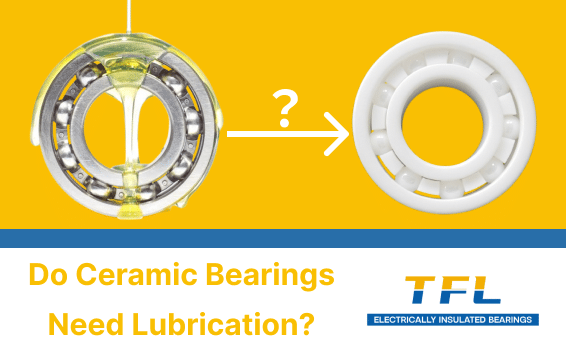
Do ceramic bearings need lubrication? The answer is short and simple, yes, nearly always. Seek the truth on lubrication of ceramic bearings, and some will regurgitate the notion that ceramics do not require lubrication. Silicon nitride does reduce friction, but it never removes the need for a film between the rolling element and the raceway. Twenty years on the bench has shown the answer to this.
Quick Answer
In practically every industrial use, ceramic bearings require lubrication. Hybrid ceramic bearings, consisting of silicon nitride (Si₃N₄) balls and steel rings, cannot do without a film at any time. Only a full ceramic bearing can operate in a dry run condition, and at a price: slower, less load.
- There are no exceptions, a hybrid ceramic bearing requires grease or oil.
- The weight of silicon nitride is 3.2 g/cm³, lighter than the chrome steel’s 7.8 g/cm³.
- Fill 1/3 of the bearing clearance and 1/2 of the housing cavity.
- Full ceramic runs dry over 400°C (752°F), at reduced speed and load.
- Approximately one-third of all premature bearing failures are due to a lubrication fault.
What this guide contains: ceramic’s relevance, material, type of bearing, relubrication, failure signatures, cost, and when not to buy ceramic.
Do Ceramic Bearings Need Lubrication?
Yes. In almost all rotating applications, a ceramic bearing should be lubricated, as a lubricant has three functions: it separates the points of contact, removes frictional heat from the bearing, and flushes wear debris away from the raceway surface. Ceramic helps with the first one, and very marginally.
This is the point where the confusion begins. Customers read that silicon nitride (Si₃N₄) is harder, lighter, also with a lower friction against steel, so that the entire assembly would be able to spin free. But in a hybrid ceramic bearing, the rings are still 52100 chrome steel. Steel raceways undergo the same type of fatigue, corrosion and galling as in the past.
I discovered this the hard way on a servo motor rebuild. Ceramic balls, correct fit, and half the amount of grease the catalog specified, because ceramic runs cooler. Inside one shift the housing temperature exceeded 90°C (194°F).
⚠ Warning: Do not consider the hybrid ceramic bearing as maintenance free. Steel raceways under the Hertzian contact stress are not changed by ceramic rolling elements.
Ceramic Bearing Materials: What Silicon Nitride Actually Changes
Everything downstream is related to the material: speed ceiling, heat generating properties, lubricant selection and relubrication intervals.
The workhorse is silicon nitride (Si₃N₄). The lower density reduces the centrifugal force on the balls at speed, resulting in less skidding, less heat and an increased limiting speed. Zirconia (ZrO₂), which is more rugged and denser as well as less heat resistant, has a fairly small niche in chemical and food handling work.
| Description | Si₃N₄ (Silicon Nitride) | ZrO₂ (Zirconia) | 52100 Chrome Steel |
|---|---|---|---|
| Density | 3.2 g/cm³ | 6.0 g/cm³ | 7.8 g/cm³ |
| Hardness | 1,400–1,600 HV | ~1,200 HV | 700–750 HV |
| Max continuous temperature | Up to 800°C (1,472°F) | Around 400°C (752°F) | 120°C (248°F) with standard grease |
| Electrical behavior | Insulator | Insulator | Conductor |
| Indicative unit cost vs steel | 2–4× | 3–6× | Baseline |
The insulation row is not something buyers expect to come across, but it is actually a very important one. When VFDs are installed on motors, stray current will arc across the oil film, etching the washboard fluting patterns mentioned in the TFL electrical erosion guide.
The HC6210-M-P5-C3 is used so frequently on the non-drive end of an inverter motor because the ceramic balls break the circuit.
Are your motors being operated by a variable frequency drive and have extended cable runs? If this is the case, then it is likely that life is being reduced in bearings by electrical erosion at a more rapid rate than mechanical load ever can.
Types Of Ceramic Bearings And Their Lubrication Needs
There are two ceramic families, and one steel alternative buyers continue to miss.
Hybrid ceramic bearings are a combination of steel rings and ceramic balls. They are most popular for industrial supply applications because they provide the majority of the speed and insulation at much reduced ceramic expense. They pass on all the rules on lubrication of steel without exception.
Full ceramic bearings are made of ceramic rings and ceramic balls. They are specialty products for vacuum, sea water, furnace atmosphere and strong acids. These can run dry and have about 1/3 of the load rating of an equal size steel bearing.

When speed is not an issue, electrically insulated steel bearings such as the 6212-2RS/HC5 solve the stray current on their own, at a more affordable price.
| Bearing | Lubrication | Use | Cost |
|---|---|---|---|
| Hybrid ceramic | Grease or oil, required | High speed, VFD motors, spindles | 2–4× steel |
| Full ceramic | None required, dry capable | Vacuum, acid, 400°C+ | 3–6× steel |
| Insulated steel (Al₂O₃ coated) | Grease or oil, required | Stray current, normal speed | 1.5–2× steel |
| Standard chrome steel | Grease or oil, required | General industry | Baseline |
I would only use full ceramic if the environment actually can destroy lubricant. All other areas are hybrid or insulated. TFL supplies all four families, inclusive of 5,000+ bearing models, therefore the choice can be made on the engineering basis, knowing availability is not an issue.
The Complete Guide To Oil, Grease And Dry Running!

1. Why Ceramic Still Needs A Lubricant Film
The load is still carried by the steel raceways in contact with the ceramic rolling elements. If no film exists, adhesive wear, surface distress and heat will result. Silicon nitride does reduce friction acceptably against steel, but never contact stress. Lubrication removes heat and cleans dirt. Both functions still have their significance.
2. Grease: The Default For Sealed Hybrid Ceramic Bearings
When I send ceramic bearings, most of them, including the HC 7214 E.TPA, leave the factory with the grease in them. No plumbing is required; grease stays where it is and seals contaminants out. Grease is the safe choice and the most cost-effective method of lubrication for motors, pumps or fans operating below 15,000 rpm.
- Base Oil Viscosity: First, choose viscosity according to ISO 3448, with the help of speed and temperature. Everything else follows.
- Thickener Compatibility: Lithium complex, polyurea and calcium sulfonate complex do not mix, and what you have got is classified via DIN 51825.
- Fill Volume: One-third of the bearing clearance and half of the housing cavity. Write both numbers on the work order.
3. Oil: When Heat And Speed Take Over
Once the bearing has passed about 15,000 rpm, or 120°C, grease begins to lose the battle. Heat is removed from the bearing by the oil, which constantly flushes out wear debris. The oil bath suits shafts which are slow running, circulating oil suits hot gear boxes, and oil-air suits a spindle which climbs 2 to 3 times over its grease-limited speed.
- Oil Bath: The lowest rolling element is located in oil, which is low shaft velocity, low cost and simple to operate.
- Circulating Oil: Pumped supply and filtered, it continuously cleans and cools hot gearboxes.
- Oil-Air Mist: Metered droplets on a stream of air, which is standard practice for HCB7007-C class spindle bearings.
4. Dry Running: What Full Ceramic Can Actually Do
Full ceramic bearings, ceramic rings and ceramic balls, run with no oil in vacuum, strong acids or furnace heat. Do not expect 100% of the specified speed or service life. Dry running is a compromise you take; it is not an upgrade you purchase.
- Speed Ceiling: Dry ceramic runs much lower than its lubricated rating, as there is no carrier out for generated heat.
- Chemical Immunity: Acids, solvents and sea water destroy the lubricants long before they have an impact on zirconia (ZrO₂).
- Thermal Range: Silicon nitride has a dimensionally stable temperature well in excess of any base oil’s survival temperature.
5. Hybrid Versus Full Ceramic: The Lubrication Split
Hybrid bearings have steel rings, and therefore all the rules of steel bearings apply: viscosity, film thickness and relubrication interval. That changes when it involves full ceramic bearings, as ceramics are not afraid of dry contact. The two are often mixed up, and this is how buyers find themselves running a hybrid spindle dry and scrapping it within a week.
6. Choosing The Right Grease Thickener And Base Oil
Thickener is responsible for survival; base oil is responsible for lubrication. The lithium complex can be used to cover most motors to a temperature of about 140°C, while the polyurea is best used on sealed-for-life high-speed motors. The unique feature of calcium sulfonate complex is its resistance to water and dust. Perfluoropolyether is chemically inert to 260°C, just be mindful of the price. Select base oil viscosity for speed and temperature.
- Lithium Complex NLGI 2: General industrial default, as it is pumpable, good at any temperature, and is on all supplier shelves.
- Calcium Sulfonate Complex: Good resistance to washout with water and excellent oxidation resistance, for duty at cement, mineral mines, steel and washdown.
- Perfluoropolyether (PFPE): Chemically inert to 260°C (500°F), very costly, and will not mix with nearly all other greases.
7. Relubrication Intervals That Actually Hold Up
Catalog intervals assume clean, cool, moderate speeds. Few real plants are eligible. Grease life is reduced by approximately 50% for each 15°C increase over 70°C. It is reduced again in half when there is a high level of contamination. Begin with the manufacturer’s figure and add correction factors determined by yourself before developing a maintenance program. Your workshop is not covered by any catalog.
- Temperature Correction: Reduce the interval by half for every 15°C of housing temperature over 70°C (158°F).
- Speed Factor: The more the dn value, the more grease is sheared, and the two factors which help are lighter base oils and shorter intervals.
- Contamination Penalty: Dust, washdown water or process spray reduces it by another half.
8. Over-Greasing: The Mistake I See Most
Too much grease is no protection. Churning of the bearings is caused by the bearings being overfilled, and this churning causes a rise of temperature which the housing cannot shed. Fill 1/3 of the bearing clearance and approximately 1/2 of the housing cavity. Under a fully packed cavity, ceramic’s low friction is actually turned to its detriment. New spindles have been seen in the industry to be cooked in two weeks.

9. Failure Signatures That Point Back To Lubrication
Damage can be classified based on ISO 15243 standards, and there are easily identifiable fingerprints for lubrication failures. Glazed mirror-bright raceways mean the film collapsed. Carbonized grease is black, indicating that it has been exposed to a higher degree of heat. If chipping is in ceramic balls, it will be related not to brittleness, but to the debris. Read the failed bearing before ordering its replacement.
What Happens If You Run Ceramic Bearings Dry?
A hybrid ceramic bearing will break down and cease to function when operating dry, in a matter of hours to days depending on load and speed. When the elastohydrodynamic film breaks on the steel raceway, the ceramic surfaces come into contact with the steel, high temperatures result, the rings expand, the clearance collapses and the bearing seizes. This damage is exacerbated by the ceramic hardness, since the harder ball pushes the raceway.
When the full ceramic bearing runs dry, it runs on, but quietly pays. Rolling resistance rises. With nothing to flush it away, debris accumulates. Noise climbs.
However, there are vacuum coating chambers, areas handling chlorine, sterilization equipment and more, where there is no alternative. No one expects a five-year life there anyway.
Where Ceramic Is The Wrong Purchase
On slow, cool, well-sealed machinery, ceramic wastes money. Silicon nitride is not useful for a conveyor pulley which runs at 200 rpm. As long as your failure can be attributed to contamination, or misalignment, or wrong fits, ceramic will fail just as quickly, but with a bigger invoice. Solve the root cause in the first priority line, as written in the TFL TCO selection guide.
At these prices, authenticating ceramic is a definite priority. Before accepting a shipment, inspect quality of ring engraving, packaging traceability and test documents.
⚠ Pro Tip: Before you attribute the fault to ceramic, measure housing temperature during a normal shift. If it is above 80°C (176°F), the interval is wrong, not the bearing.
Maintenance Tips: Intervals, Fill Volumes And Cleanliness
Getting the right lubricant for ceramic bearings requires three numbers: operating speed, sustained operating temperature, and sustained level of contamination. Everything else follows.
The proper lesson was acquired from a cement clinker cooler fan. Standard bearings were failing within four to five months, but hybrid ceramic balls with calcium sulfonate complex grease and triple sealing extended the interval beyond 15 months, reducing unplanned downtime by more than 70% and saving approximately $32,000 USD each year, as documented in the TFL clinker cooler fan case.
The second lesson was attributed to a CNC spindle that was using coolant contaminated grease, and which was rebuilt every eight to 10 months. It passed the 24-month mark with a hybrid ceramic bearing in place that had the correct sealing and oil-air feed, and it returned just over $27,600 USD per year. The original problem was not the bearings. The lubrication system was.
| Duty | Lubricant | Interval | Avoidance |
|---|---|---|---|
| Motor, 3,000 rpm, 70°C | Lithium complex NLGI 2 | 4,000–8,000 hours | Over-filling the cavity |
| Spindle, 18,000 rpm | Oil-air, ISO VG 32 | Continuous metered feed | Moisture in air line |
| Fan, 180°C, heavy dust | Calcium sulfonate complex | 800–1,500 hours | Grease carbonization |
| Washdown food line | NSF H1 PFPE | 1,000–2,000 hours | Water washout |
| Vacuum or 400°C+ | Full ceramic, dry, none | Not applicable | Reduced load rating |
Cleanliness should have a line of its own. Grit gets into grease guns, nipples collect grit, and hands collect grit. A hard particle in a raceway becomes a stress riser, and ISO 281 life calculations do not account for it.
⚠ Warning: Compatible thickeners must not be mixed with other noncompatible thickeners, otherwise a grease can, over days or weeks, transform into a liquid. Switch entirely, or do not switch at all.
Bottom Line Up Front
- The majority of duty below 15,000 rpm and 120°C is grease protected.
- Oil-air lubrication makes it possible to increase spindle speed 2 to 3 times.
- Grease service life is about halved every 15°C above 70°C.
- Too much grease produces more failures of ceramics than too little.
- Full ceramic dry running cuts usable load rating by about two-thirds.
Looking to check your own application? Provide the bearing designation with a suffix, the shaft speed, the temperature at which the housing is operating, and the lubricant in place, to TFL.
Quotes and technical review are returned within 24 hours, with ISO 9001:2015 certification, 50+ pre audited factories and 98% on time delivery to more than 50 countries. The mixed model list is accepted via the bearing cross-reference hub.
People Also Ask
Do hybrid ceramic bearings need lubrication?
Yes, always. With hybrid bearings, the balls are made of silicon nitride, but the raceways are made of steel and require a lubricant film. Sealed or circulating grease or oil, but never dry, unless otherwise designated by the manufacturer.
What is the best lubricant for ceramic bearings?
No single best lubricant for ceramic bearings exists. Ensure that thickener and base oil are matched to temperature, speed and contamination requirements. Lithium complex NLGI 2 will cover the vast majority of industrial motors.
Can ceramic bearings run without grease?
Only full ceramic versions can, and with difficulty. Ceramic rings are able to withstand dry contact in vacuum, acid or extreme heat. Both speed and load ratings are greatly reduced, therefore consider dry running as a last resort.
How often should ceramic bearings be relubricated?
For standard motors, approximately every 4,000 to 8,000 hours, or half that when the housing is at a temperature higher than 70°C. High speed spindles are provided with continuous oil-air feed rather than scheduled feedings.
Does lubrication cancel the ceramic speed advantage?
Not if it is the right size. Too much grease equates with greater expense than ceramic will ever benefit. Fill one-third of the free volume, select a light base oil, and the benefit remains.
Conclusion
The cost of ceramic is 2 to 4 times that of steel, and a poorly selected grease wastes this advantage in just a few months. That said, the answer to do ceramic bearings need lubrication is still one of simplicity: match the film to the duty, and check it regularly. Please email your bearing list to TFL for a 24-hour lubrication and cross reference review. Film first.