

Short Answer
An insulated bearing and an insulated housing both act as physical roadblocks that stop stray electrical current from passing through the motor bearings. The main difference is where that roadblock is placed.
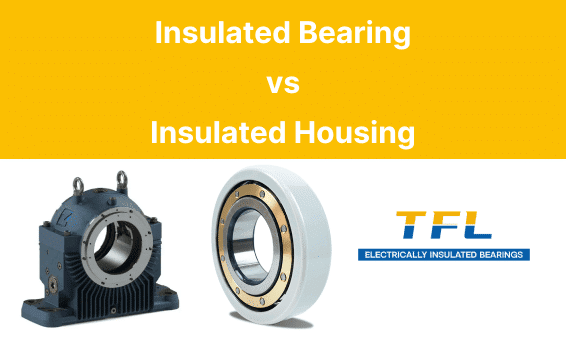
An insulated bearing builds the barrier on the bearing itself, typically using a thin 0.1 mm ceramic coating on the inner or outer ring. An insulated housing allows you to use a standard bearing, placing the insulation directly into the motor’s end shield or housing bore.
Of the main motor bearing insulation methods, the insulated bearing is usually the simpler choice for motors with ball and roller bearings, as it has standard dimensions and fits without machining. Housing insulation suits plain-bearing machines and new designs that need a thicker barrier.
Key takeaways
- An insulated bearing fits like a standard one, so it suits repairs. Housing insulation needs a housing designed or machined for it.
- On a variable frequency drive (VFD), insulation thickness and area matter more than the DC voltage rating. A thicker housing barrier often performs better.
- A factory-fitted insulated bearing must be replaced with the same insulated type matched to the full designation.
- Neither method protects a gearbox or pump coupled to the motor. Bonding the motor frame to the driven machine is the most effective precaution.
Why Do Motor Bearings Need Insulation?
If you are a lead engineer, you may have experienced a critical motor suddenly making strange noises and vibrating violently, and eventually the line going dark. The cause? A tiny and invisible spark causing electrical bearing damage.
Motor bearings are designed only to handle mechanical loads and support the rotating shaft inside the housing. When voltage builds up on the shaft, the current finds the easiest path to the grounded frame, often running through the bearings.
Inside a standard bearing, the only barrier that keeps the metal components from getting in contact is the film of grease between the balls and the raceways. GAMBICA/BEAMA guideline states that the film breaks down at around 30 to 50 V. Moreover, Schaeffler research shows that the lubrication film becomes very thin at low operating speeds. So, the grease starts acting like a resistor instead of an insulator, allowing stray currents to flow at even lower voltages.
Each spark across the film melts a microscopic crater into the steel. After millions of such cycles, the raceway turns dull gray and develops a washboard-like pattern known as fluting. Meanwhile, the heat burns the high-quality grease black.
This damage can happen in any motor, but the primary catalyst is the variable frequency drives. A VFD controls motor speed by switching its output voltage thousands of times per second. This switching creates massive voltage spikes, and ABB reports that without protection, these spikes can trigger electrical bearing failures within one to six months of drive start-up. NEMA MG 1 Part 31 recommends insulating one bearing when peak shaft voltage exceeds 300 mV, mainly on motors of 500 frame and above.
Here are the two types of bearing currents causing the problem:
- Circulating currents: This current flows in a loop through both bearings and the motor frame. ABB links it mainly to larger machinery from about IEC frame 280. To solve it, we break the circuit, usually by insulating the non-drive end (NDE) bearing on the fan side.
- Discharge currents: This current is driven by the fast voltage pulses of the VFD. It jumps from the shaft to the frame through either bearing where the grease film breaks down. ABB recommends protecting both bearings in motors below IEC frame 250 and states that hybrid bearings are the safe solution.
What Is an Insulated Bearing?
Think of an insulated bearing as a premium ball or roller bearing with a built-in electrical shield. Bearing ring insulation is the most common approach.
Manufacturers take a standard bearing and spray an aluminum oxide ceramic coating onto the outer or inner ring. Once applied, the ceramic is sealed to keep out moisture that could ruin its electrical resistance.
The coated bearing matches the DIN 616 (ISO 15) international sizing standard. Here are their published ratings:
- SKF utilizes a nominal coating thickness of about 100 µm. It can withstand up to 3,000 V DC with at least 200 MΩ of resistance.
- Schaeffler offers its J20G series in 120 µm and 200 µm thicknesses, rated for at least 3,000 V DC protection and 250 MΩ resistance.

To identify these parts, check the suffix when ordering. SKF uses VL0241 for a coated outer ring and VL2071 for a coated inner ring. Schaeffler uses J20GA (outer) and J20GI (inner). TFL’s inner vs outer ring insulation guide compares the two.
ABB fits an insulated NDE bearing to its own motors from IEC frame 280 upward. Insulated bearings are also heavily relied upon in high-stakes applications like wind turbines.
What Is Bearing Housing Insulation?
While insulated bearings protect the bearing itself, bearing housing insulation places the insulation in the stationary frame that holds it, usually the end shield (or end bracket). Hence, you can use a standard, off-the-shelf steel bearing. Here are different ways engineers achieve this housing barrier:
- Insulated bearing sleeves or bushings: pressed into the housing bore, with the bearing fitted inside.
- Cast-in-Place Insulating Rings: DuPont describes them as polyimide rings placed in the mold before an aluminum motor housing is die-cast. The housing is then machined to size.
- Coated Bearing Seats: For massive, heavy-duty industrial equipment using pedestal or plain/sleeve bearings, manufacturers like Miba apply the insulating coating directly to the bearing seat.
GAMBICA/BEAMA stated that housing insulation is normally thick enough to stop bearing currents and can sometimes be retrofitted.
A specialized motor repair shop in Kansas City solved a recurring headache: they often saw vertical pump motors from water and wastewater treatment plants arrive with destroyed bearings.
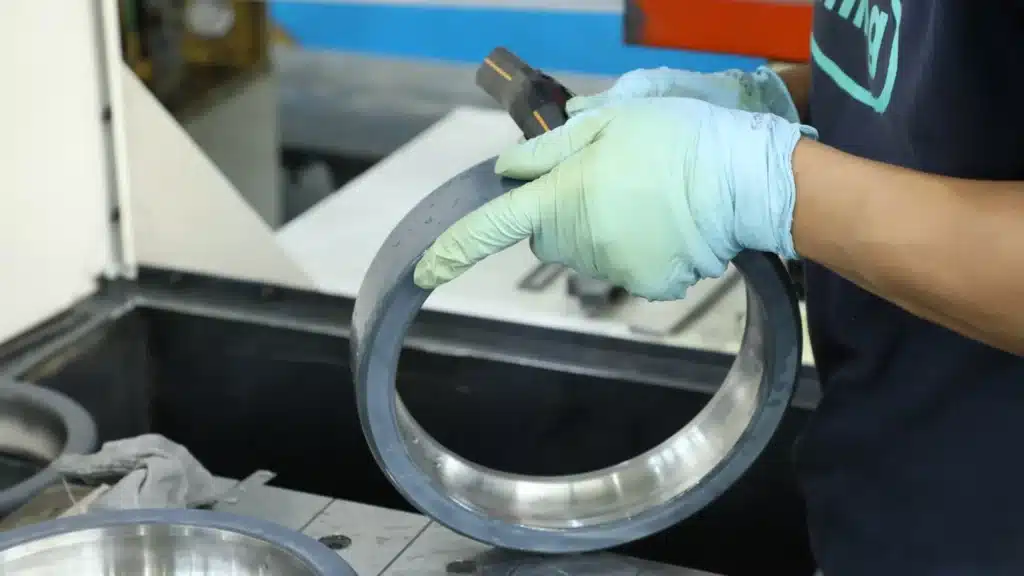
The shop started retrofitting the motors, taking the carrier (component holding the upper thrust bearing) and coating it with a custom ceramic layer, keeping the bearing standard. Every finished carrier measures more than 1,000 MΩ at 1,000 V.
The repair combined ceramic insulation on the upper thrust-bearing carrier with a shaft grounding ring near the lower guide bearing. The 2013 report stated that hundreds of motors treated with this combined approach had experienced no repeat bearing failures during the reported period.
Insulated Bearing vs Insulated Housing: A Comparison
| Factor | Insulated bearing (coated ring) | Insulated housing |
|---|---|---|
| Barrier thickness | About 100 to 200 µm | Can be much thicker, such as 1 to 2 mm polymer sleeves |
| Fit | Same dimensions as the standard bearing | Housing or shaft must be designed or machined for it |
| Future replacements | Must be the same insulated type | A standard bearing of the right size fits |
| Performance on a VFD | Lower, because the thin layer passes some high-frequency current | Often better, because a thicker barrier passes less |
| Main risk | A standard bearing fitted by mistake, or a chipped coating | Metal parts such as sensors, bolts, or encoders that bridge the barrier |
| Best suited to | Motors with ball or roller bearings, including repairs | Plain-bearing machines and new designs |
Does Insulation Thickness Matter on a VFD?
A thin layer of insulation between two metal surfaces acts like a capacitor. While it easily blocks steady DC voltage, the lightning-fast voltage pulses from a VFD rapidly charge and discharge the layer, driving high-frequency current through it.
Schaeffler states this high-frequency leakage worsens if the insulated surface area is too large or if the coating is too thin. Once you pass several hundred kilohertz (kHz), the coating thickness and surface area determine how well the bearing is protected.
Schaeffler’s impedance measurements on a 6314 bearing at 100 kHz show the effect:
| Schaeffler variant | Coated ring | Coating thickness | Impedance at 100 kHz |
|---|---|---|---|
| J20GA | Outer | 120 µm | 273 Ω |
| J20GB | Outer | 200 µm | 428 Ω |
| J20GI | Inner | 120 µm | 583 Ω |
The thicker coating increases impedance by about 57%. Interestingly, the inner-ring version performs best because the bore has less surface area to coat. If high-frequency current is your main problem, hybrid bearings perform better still.
They typically have a capacitance of 40 pF, about 100 times lower than coated bearings. Schaeffler also recommends them over coated bearings below 120 mm outside diameter.
On thickness alone, a housing sleeve 1 to 2 mm thick has the physical advantage over a 0.1 mm coating. The GAMBICA/BEAMA report warns that a thin coating alone may not be enough to completely eliminate high-frequency VFD currents.
Which Should You Choose?
| Situation | Usual choice |
|---|---|
| Replacing factory-fitted insulated bearing | The same insulated type that is matched to the full designation |
| Larger VFD motor with circulating current | Insulated bearing at the NDE where appropriate |
| Small motor on a fast-switching drive | Hybrid bearings (often at both ends), or a shaft grounding ring |
| Machine with plain (sleeve) bearings | Housing or pedestal insulation designed for that machine |
| New motor design requiring thicker insulating barrier | Housing insulation |
| Motor coupled to a gearbox or pump | Assess frame-to-load bonding and whether insulated coupling is needed |

Even with insulated motor bearings, current can still travel through the coupling and damage the bearings in a gearbox or pump, while the motor continues to run.
NEMA MG 1 states that insulating the motor bearings won’t prevent damage to the other shaft-connected equipment. The GAMBICA/BEAMA report describes bonding the motor frame to the driven machine as “the single most effective precaution.”
How Do You Check That the Insulation Works?
Once everything is assembled, don’t assume the barrier is working. You need to test it using an insulation resistance tester (megohmmeter/megger). Test the bearing insulation using the motor or bearing manufacturer’s specified procedure. A satisfactory DC insulation resistance reading does not, by itself, demonstrate adequate protection against high-frequency bearing currents in a VFD application.
However, new insulated bearings read much higher. NTN quotes at least 100 MΩ at 500 V DC, while SKF targets at least 200 MΩ. If you test and see a massive drop from these factory numbers, it immediately points to moisture, contamination, physical damage, or an accidental electrical bridge.
The golden rule: For either method, the reading must be taken across the insulation alone, with no parallel path. TFL’s guide on testing insulation resistance describes the test setup.
What to Specify When Buying an Insulated Bearing
An “insulated 6316” is not enough to identify the correct replacement. Include:
- The full original designation with every suffix, such as 6316/C3VL0241.
- Whether the inner or outer ring should be insulated, or if you need a hybrid bearing.
- The DC breakdown voltage and minimum resistance with the test conditions.
- Motor and drive details, such as motor power, frame size, drive type, and bearing position.
- Whether you need an electrical test report or other product documentation.
TFL’s guide to 1,000 V DC ratings vs high-frequency performance explains how to compare these figures.
How TFL Can Help You Protect Against Shaft Current Damage
TFL offers its own brand of electrically insulated bearings, covering bore sizes from 40 mm to over 300 mm, with a 50 to 100 µm aluminum oxide coating. This coating provides at least 1,000 V DC breakdown strength, and special models reach 3,000 V DC. If your original bearing is rated higher than b, state the rating in your request.
For smaller motors on high-speed, fast-switching drives, TFL also supplies hybrid ceramic bearings to reduce capacitance issues.
Where specific certificates or test reports are required, TFL confirms their availability and applicability to the quoted products before order acceptance. Third-party testing can be arranged when required.
RFQs receive a response within 24 hours, and TFL’s on-time delivery rate is 98%. To get started, send your spec details and photos of any damaged bearings through TFL’s contact page.
Frequently Asked Questions (FAQ)
1. Should I insulate one bearing or both?
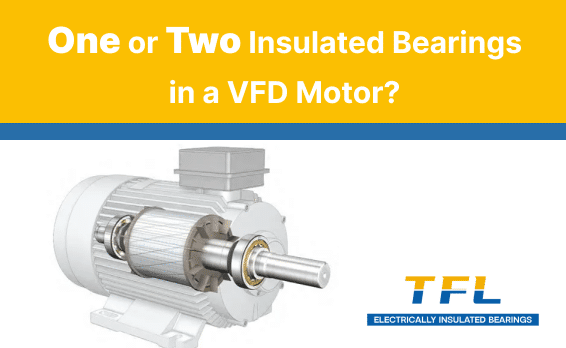
One insulated NDE bearing stops circulating current in larger motors. Smaller motors with discharge current need protection at both bearings or shaft grounding. See one or two insulated bearings in a VFD motor.
2. What is an insulated bearing sleeve?
It is a non-conductive sleeve fitted between a standard bearing and the housing or shaft. Fitting one usually requires machining.
3. Can bearing insulation be combined with a shaft grounding ring?
Yes. A New Jersey repair shop described in Pumps & Systems combined an extra-thick ceramic coating on the upper bearing carrier with a shaft grounding ring at the lower end, on two of six 150 hp vertical motors.
4. Can an insulated bearing be replaced with a standard bearing?
Not where the motor maker fitted an insulated type. The GAMBICA/REMA installation guide states that any replacement for such a bearing must be a compatible type.
Technical References/Reading
- GAMBICA/BEAMA, Motor Shaft Voltages and Bearing Currents under PWM Inverter Operation, technical report, 3rd edition (2016).
- GAMBICA/REMA, Installation Guide for Power Drive Systems, 4th edition (2012).
- Schaeffler, TPI 206: Current-Insulating Bearings.
- Schaeffler, Against the current (J20G series), January 2025.
- Hannover Messe, Bulwark against parasitic currents (Schaeffler J20G series, February 10, 2025).
- SKF, INSOCOAT bearings brochure, PUB BU/P2 17401 EN (May 2017).
- SKF Evolution, Prevention of electric erosion in bearings.
- NTN, Insulated Bearings MEGAOHM Series, CAT. No. 3030/E.
- ABB, Bearing currents and how to beat them.
- ABB, Bearing currents: options (9AKK107336, 2018).
- ABB, Technical guide No. 5: Bearing currents in modern AC drive systems.
- Machine Design, Shielding bearings: grounding helps inverter-duty motors live up to their name (NEMA MG 1 Part 31).
- DuPont, Bearing insulation made of Vespel polyimide for the prevention of damage in electric motors.
- Miba Industrial Bearings, Pedestal Bearing ZR/ZG catalog.
- Pumps & Systems, Mitigate electrical bearing damage in vertical pump motors.