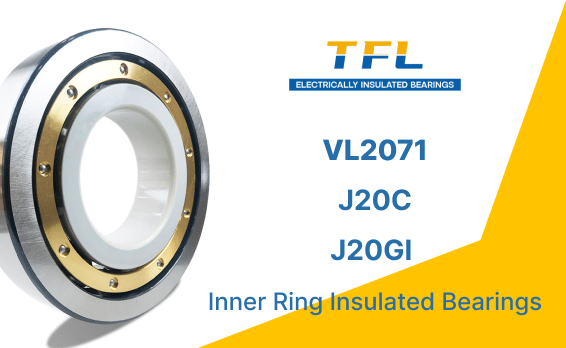


An insulated bearing is a bearing with an electrically non-conductive layer, usually an aluminum oxide ceramic coating on the outer or inner ring. It interrupts unwanted current passing through the motor shaft, rolling elements, and housing, helping prevent electrical pitting, fluting, lubricant damage, noise, and premature motor bearing failure.
To select the correct insulated bearing, confirm the complete model number, dimensions, load, speed, internal clearance, coating position, insulation requirement, operating environment, and whether it is installed as a drive-end or NDE bearing. For selection support, send your motor and bearing details through the TFL Bearing contact form.
Are you tired of replacing motor bearings ahead of schedule due to unexplained noise and vibration?
If you run modern electric motors—especially those controlled by Variable Frequency Drives (VFDs)—stray electrical currents may be damaging your bearings from the inside out. Replacing the failed bearing without addressing the current path may only provide a temporary solution.
In this guide, we will break down exactly how insulated bearings work. You’ll discover:
- The microscopic electrical discharges happening inside a motor bearing.
- How insulation voltage specifications affect bearing selection.
- Why the outer ring is commonly coated in many motor applications.
- When an insulated NDE bearing may be required.
- What information is needed to identify a suitable replacement model.
What Is an Insulated Bearing? Definition and Working Principle
At first glance, an electrically insulated bearing looks almost identical to a standard bearing. In many product series, the main boundary dimensions remain the same as those of the corresponding standard bearing. The key difference is a thin but robust layer of ceramic insulation applied to one of the bearing rings.
The complete bearing designation must still be checked before replacement. Internal clearance, cage material, seals, precision, load rating, speed capability, coating position, and insulation specification may differ even when the main dimensions are the same.
The Basic Concept: Breaking the Circuit
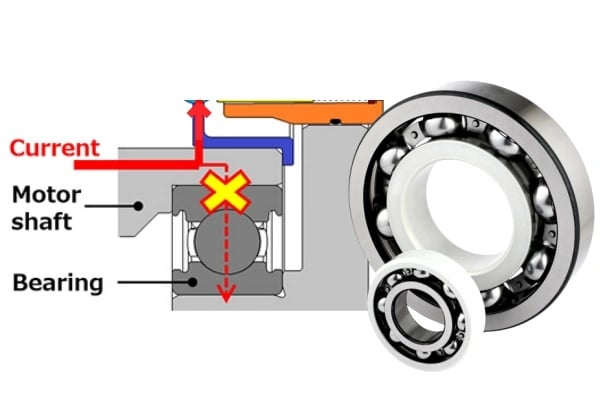
Think of your motor shaft, bearing, and housing as parts of an electrical circuit. In a VFD-controlled motor, high-frequency voltage can build up on the shaft. When this voltage exceeds the insulating capability of the lubricant film, it may discharge through the rolling elements and raceways.
Insulated bearings introduce a component with high electrical resistance into this path. By coating the outer ring, which is the most common arrangement, or the inner ring, the bearing interrupts current flow between the shaft and motor housing.
This helps prevent current from arcing through sensitive bearing raceways. Depending on the motor and drive system, insulated bearings may be used together with shaft-grounding brushes, appropriate cabling, grounding, bonding, or filtering measures.
The Core Problem: Why Do We Need Insulated Bearings?
To understand the solution, we must first look at the damage caused by stray currents. When electrical voltage passes through a bearing, it does not always flow smoothly. Instead, it may discharge across the lubricant film. This phenomenon is commonly described as electrical erosion or EDM-related bearing damage.
Understanding Electrical Erosion
Inside a running bearing, the rolling elements ride on a microscopic film of oil or grease. This lubricant film can act as a natural electrical barrier—but only up to a certain voltage level.
When shaft voltage, which is common in some VFD motor systems, exceeds the dielectric strength of the lubricant film, the voltage can punch through. This creates a small electrical arc between the raceway and the ball or roller.
The localized temperature created by the discharge can damage or melt a microscopic area of bearing steel. As the bearing continues to rotate, these damaged points separate, leaving behind small pits or craters.
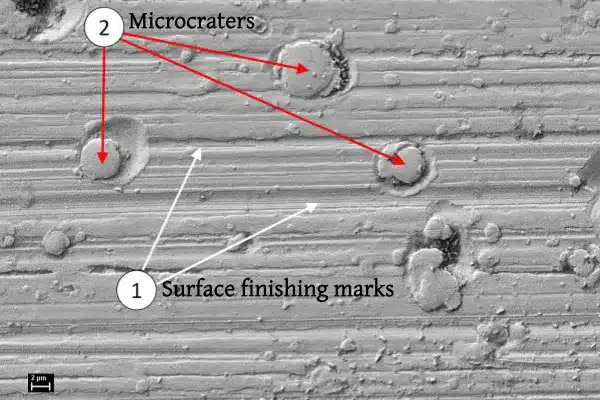
From Pitting to Fluting
The damage shown above is only the first stage. As thousands of micro-craters accumulate, they change the surface condition of the raceway. The rolling elements begin to vibrate as they pass over the damaged surface.
This vibration and repeated discharge activity can eventually form a rhythmic pattern of parallel ridges known as fluting or washboarding. Once fluting develops, common symptoms include:
- A distinct high-pitched whining or humming noise.
- Increasing vibration levels.
- Rapid degradation or darkening of the grease.
- A frosted gray appearance on the raceway.
- Repeated bearing failure after replacement.
The Role of VFDs: Variable Frequency Drives
Why is this problem more common in modern motor systems? One reason is the widespread use of Variable Frequency Drives.
VFDs are effective for controlling motor speed and improving energy efficiency. However, their high-frequency switching can create common-mode voltage and other high-frequency electrical effects. Depending on the motor, cabling, grounding, and driven equipment, current may find a path through the motor bearings.
A standard bearing can therefore become part of the electrical path even though it was selected only for mechanical load and speed.
Expert Inspection Tip
Electrical erosion can sometimes be mistaken for ordinary fatigue, contamination, or lubrication failure. If a failed bearing has a frosted gray raceway, microscopic electrical pits, parallel fluting marks, or unusually dark grease, investigate the motor’s electrical current path before installing another standard bearing.
An insulated bearing, shaft-grounding device, improved grounding, cable correction, or filtering may be required depending on the complete motor and drive system.
Inside the Technology: Plasma Spraying and Material Composition
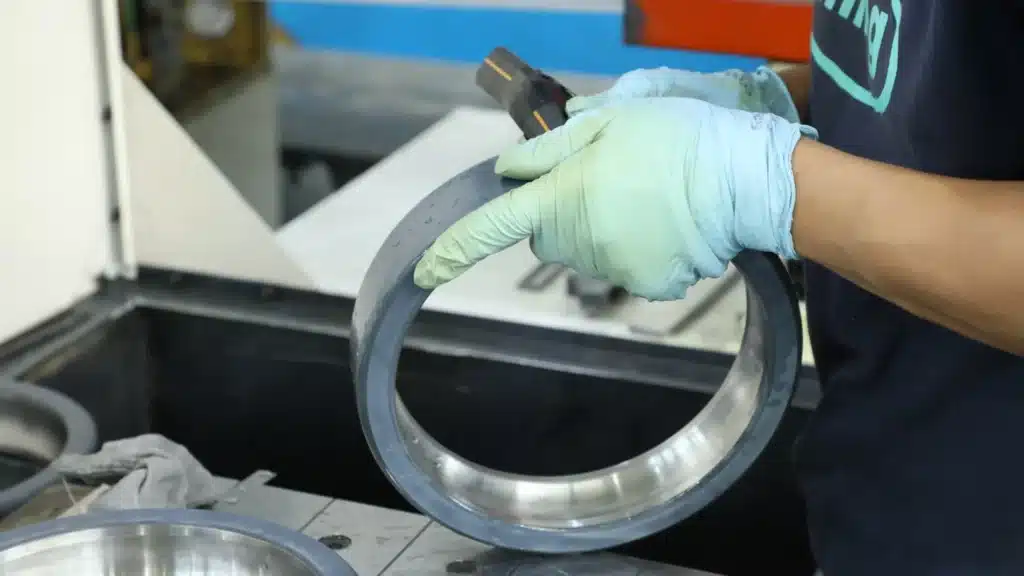
One common industrial method for producing ceramic-coated insulated bearings is plasma spraying.
Aluminum Oxide Ceramic Coating
Aluminum oxide ceramic is widely used as an insulation material because it combines hardness, wear resistance, thermal stability, and high electrical resistance.
- Surface preparation: The bearing ring surface is prepared to help the coating bond securely to the steel.
- Spraying: Ceramic powder is introduced into a high-temperature plasma jet and deposited onto the bearing ring.
- Bonding: The heated particles strike the prepared steel surface and form a bonded ceramic layer.
- Sealing: Because a plasma-sprayed coating may contain microscopic porosity, a sealant can be applied to reduce moisture penetration and maintain electrical resistance in humid environments.
- Finishing: The coated surfaces are finished to the required dimensions and surface condition.
The coating process must preserve the bearing’s dimensional accuracy and should not interfere with the shaft or housing fit. Installation tools should apply force only through the correct bearing ring and must not damage the ceramic coating.
Understanding Insulation Ratings: 500V DC, 1000V DC, and 3000V DC
When selecting an insulated bearing, the electrical specification is an important part of the design. The stated insulation voltage describes the test or breakdown-voltage capability of the coating system under defined conditions.
Commonly requested specifications include 500V DC, 1000V DC, and higher-voltage options. However, the motor’s nameplate voltage should not be used as the only selection criterion. High-frequency voltage pulses, insulation resistance, coating thickness, test method, humidity, bearing size, and current path must also be considered.
| Requested Insulation Level | General Selection Consideration | Important Check |
|---|---|---|
| 500V DC | May be specified for applications with lower insulation requirements or existing equipment designs. | Confirm the original motor or bearing specification before using it in a modern VFD system. |
| 1000V DC | A commonly requested specification for industrial motors, generators, pumps, fans, and other VFD-driven equipment. | Verify the manufacturer’s test method, insulation resistance, coating position, and complete bearing designation. |
| 3000V DC or higher | May be required for certain traction motors, generators, wind power equipment, or applications with higher electrical protection requirements. | Do not select the higher voltage level automatically; confirm the actual motor and system requirement. |
Selection Note
For many general industrial enquiries, customers request a 1000V DC insulated bearing. However, the correct specification should always be confirmed from the motor drawing, original bearing designation, OEM requirement, or electrical-system analysis.
A higher voltage rating does not correct an unsuitable bearing type, incorrect clearance, poor lubrication, excessive load, or improper grounding.
Replacement and Equivalent Model Notes
Insulated-bearing suffixes are manufacturer-specific. A suffix used by one brand may describe the coating position, voltage class, coating material, or another design detail, but it may not directly match the suffix used by another manufacturer.
When replacing or cross-referencing an insulated bearing, compare all of the following:
- Base bearing type and complete model number.
- Bore, outside diameter, and width.
- Internal clearance, such as normal clearance, C3, or C4.
- Cage material and cage design.
- Seals or shields.
- Outer-ring or inner-ring coating position.
- Insulation voltage and resistance specification.
- Operating speed, load, temperature, and lubrication.
- Drive-end or non-drive-end installation position.
Do not approve an equivalent replacement from a shortened suffix alone. The complete bearing and motor specifications must be compared.
Key Applications: Where Are Insulated Bearings Used?
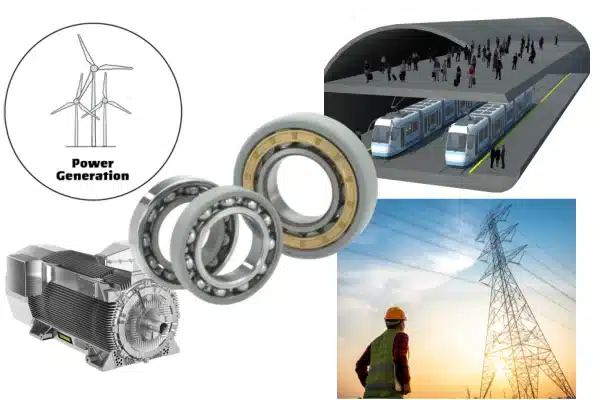
Insulated bearings are used in many applications where bearing current can cause electrical erosion, lubricant degradation, vibration, and premature failure.
1. Industrial Electric Motors Driven by VFDs
This is one of the most common insulated-bearing applications. Pumps, compressors, fans, conveyors, and production equipment controlled by inverters may experience high-frequency bearing currents.
Replacing a standard deep groove ball bearing with an insulated equivalent can be a practical upgrade during maintenance, but the full model, clearance, cage, seals, coating location, and motor arrangement must be checked first.
For available product types, review our insulated bearings for electric motors or browse the complete TFL bearing product range.
Why Is the NDE Bearing Often Insulated?
The NDE bearing is the bearing installed at the non-drive end of the motor, opposite the coupling, pulley, gearbox, or driven equipment.
In many motor arrangements, an insulated NDE bearing is used to interrupt a circulating electrical-current path through the shaft, bearings, and motor frame. This is a common design, but it is not a universal rule. Some systems also require shaft grounding, drive-end protection, cable correction, or filtering.
The correct arrangement should be confirmed from the motor drawing, OEM specification, drive system, and failure evidence rather than from motor power alone.
2. Railway Traction Motors
Railway traction motors operate under demanding electrical, mechanical, and environmental conditions. Varying speed, high-frequency drive systems, vibration, and difficult maintenance access can increase the importance of bearing-current protection.
Depending on the motor design, railway traction motor bearings may use ceramic-coated insulated bearings or hybrid ceramic designs. The coating position and insulation specification should follow the motor’s technical requirements.
3. Wind Power Generators
Wind turbine generators can also be exposed to shaft voltage and bearing currents. Because maintenance access is difficult and downtime is costly, bearing selection must consider electrical insulation together with load, speed, lubrication, temperature, vibration, and required service reliability.
Ceramic-coated or hybrid bearing designs may be used depending on the generator arrangement and current-protection strategy.
Frequently Asked Questions
What is the best way to choose an insulated bearing?
Start with the complete bearing model and compare the dimensions, load, speed, internal clearance, cage, seals, lubrication, coating position, insulation specification, operating environment, and drive-end or non-drive-end installation position. The bearing must meet both the mechanical requirements and the electrical-protection requirement.
When should I use insulated bearings?
Use insulated bearings when the motor or OEM specification requires electrical insulation, when electrical pitting or fluting has been confirmed, or when analysis of a VFD-driven system shows that bearing current must be interrupted. The complete grounding and drive system should also be reviewed.
What information is needed for an NDE bearing quotation?
Send the complete bearing model, dimensions, quantity, motor manufacturer and model, NDE or DE position, application, operating speed, load, VFD information, required insulation level, internal clearance, cage, seals, and any available drawings or failure photos.
What is the difference between insulated bearings and hybrid ceramic bearings?
Insulated bearings normally use steel rings and steel rolling elements, with an aluminum oxide ceramic coating applied to the outer or inner ring. Hybrid ceramic bearings normally use steel rings with silicon nitride ceramic rolling elements. Hybrid bearings may offer additional speed and electrical-performance advantages, but they are usually more expensive.
Can I use insulated bearings in standard motors without VFDs?
Yes, an insulated bearing can be used in a motor without a VFD when the motor design or electrical system requires it. However, it should not be selected automatically. Confirm the mechanical specifications, current path, grounding arrangement, and original motor requirements first.
How long do insulated bearings last compared with standard bearings?
There is no universal service-life figure. In an application where electrical current is damaging a standard bearing, the correct insulated bearing can remove that specific failure mechanism. Actual bearing life still depends on load, speed, lubrication, fit, alignment, contamination, operating temperature, and maintenance.
Do I need to ground the motor shaft if I use an insulated bearing?
It depends on the motor and drive system. An insulated NDE bearing may interrupt a circulating current path, but other high-frequency currents may still reach the shaft, drive-end bearing, gearbox, or driven equipment. Some systems also require a shaft-grounding ring, grounding brush, shielded cable, improved bonding, or an output filter.
Can an insulated bearing directly replace a standard bearing?
Many insulated bearings have the same main boundary dimensions as their standard equivalents, but a direct replacement still requires confirmation of the complete designation, internal clearance, cage, seals, precision, load capacity, speed capability, coating position, insulation requirement, and mounting method.
Can I select an equivalent insulated bearing by brand suffix alone?
No. Insulated-bearing suffixes are manufacturer-specific. Compare the complete bearing design, dimensions, clearance, cage, seals, coating position, voltage specification, resistance, load, speed, and operating environment before approving an equivalent model.
Confirm the Right Insulated Bearing Before Ordering
Send the complete bearing model, motor information, quantity, speed, load, insulation requirement, and available drawings or failure photos. TFL Bearing can help review the specification and identify a suitable insulated-bearing option.
View Insulated Motor Bearings Request Selection Support
Please include the complete bearing designation and all suffixes whenever possible.