

Reviewed by Ms Jessica Jia, Chief Technical Advisor, TFL Bearing. More than 20 years reading burn patterns, grease color and wear band position on hot bearings from kilns, oven fans and continuous casters. ISO 9001:2015 Internal Quality Auditor and Cross Reference Validation Lead. Last reviewed: September 2026.
Introduction
Thirty-two thousand dollars a year. One cement manufacturer did just that when it replaced its burned steel fan bearings with high temperature ceramic bearings. Grease is always the first thing to go before steel burns up, and most people who must buy them find this out the hard way. This is what remains above 200°C, and here is why.
Key Takeaways
- Ball Weight: The actual weight of silicon nitride (Si₃N₄) balls is about 40% of that of steel balls of the same size.
- Grease First: Nearly always, grease is the first thing to give out, as a standard lithium grease fails near 150°C (302°F).
- Clearance Class: C4 is good for temperatures higher than 150°C, C3 is sufficient to 150°C.
- Seal Rating: FKM double-lip seals are rated up to 230°C (446°F), whereas nitrile dies near 120°C.
- Ring Stability: Permanent ring growth is prevented with heat stabilized rings, suffix S1 or S2.
- Full Ceramic: For situations in which lubrication fails, full ceramic’s price is the only justification.
This page includes the following: where heat kills bearings, the materials guide in eight points, a table of materials, a cost comparison, a specifying checklist, and the buyer’s FAQ.
What Are High Temperature Ceramic Bearings?
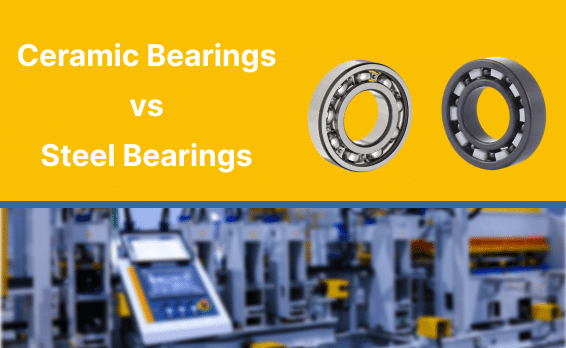
High temperature ceramic bearings are a type of rolling bearing in which the steel rolling balls or steel rolling rollers are replaced by silicon nitride (Si₃N₄) balls or rollers, the steel rings are heat treated to maintain hardness, the cage is also made of heat-resistant materials, and the lubricant is rated for the actual operating temperature. Hybrid ceramic bearings are most commonly being sold, not full ceramic bearings.
It is a distinction that involves people spending money all the time. Ceramic balls eliminate friction, thermal growth and electrical erosion. These do not alleviate grease oxidation, seal hardening or ring softening. If a hybrid is operated at 220°C with the wrong grease, it fails in about the same time frame as the steel bearing it replaced.
So, here’s a thing. Typically, the healthiest part of the entire thing at teardown is the ball. For those wishing to read the underlying metallurgy first, the bearing materials guide is provided, which involves the ring materials, the cage alloys and the seal alloys, in that sequence.
Where Heat Actually Destroys A Bearing First?
Go into any steel mill, bakery or kiln line, and the failure story is repeated. Base oil evaporates. The thickener becomes a crust and turns black. When metal rubs against metal, friction increases, the temperature rises and the bearing freezes up. This flaking is known to engineers as spalling, and it is practically always a symptom and not the cause.
Standard bearings have a life of four months in this bakery’s tunnel baking oven, which is operated 24/7 at 220°C (428°F). Grease became hard as a crust; steam condensed in it and created corrosion in raceways. In fact, in the cited TFL oven fan case, the replacement, SUS440C stainless rings, C3 clearance, FKM double-lip seals and PFPE grease rated to 260°C (500°F), successfully passed the 12 month mark and resulted in annual savings of $22,500.
That fix was nothing special. Frankly speaking, it was material selection.
⚠ Caution: No matter how often you re-grease to combat high temp, it is usually worse. If it is over-packed, it is causing the churning heat to build up within the bearing, and therefore hastening the very failure it is intended to eliminate.
A Pro Guide To Heat Limits And Materials!
1. Where The Real Temperature Ceiling Sits
Silicon nitride balls maintain their size at temperatures above 800°C, while the bearing itself ceases to function prematurely. For instance, standard GCr15 rings become soft beyond 150°C without being heat stabilized. Typically, the grease gives way between 120°C and 180°C. This means your ceiling will be whatever piece blinks first, not the ceramic.
2. Silicon Nitride Versus Steel Under Sustained Heat
Si₃N₄ is approximately 40% lighter than steel, and only expands about a third as much per degree. Constant heat translates to lower centrifugal loading, slower preload drift and reduced frictional heat back into the grease. Most of the advantage is characterized by three published material numbers.
- Density: 3.2 g/cm³ against 7.8 g/cm³ for chrome steel.
- Thermal Expansion: About 3.2 µm/m·K compared to 11.5 for bearing steel.
- Hardness: Close to 1,500 HV, which is tougher than the clinker dust causing damage to fan bearings.

3. Grease Is The Weak Link, Not The Ball
Base oil becomes oxidized, becomes viscous and carbonizes. A standard NLGI 2 lithium grease is finished in weeks at 220°C. PFPE has chemical stability to approximately 260°C, and the calcium sulfonate complex is better capable of withstanding wet heat. Pick the thickener by environment, the base oil by temperature.
- Fill Volume: One third of the free volume in the bearing, not more.
- Oxidation Margin: Specify at least 40°C above the measured peak.
- Relubrication: Halve the interval for each increase in temperature of 15°C.
The bearing lubrication guide contains more on interval logic.
4. Clearance Math When The Inner Ring Runs Hotter
Normally, the inner rings are 5°C to 10°C hotter than the outer rings, and that gap is used up for radial clearance. C3 is applicable to most work up to 150°C, while C4 or C5 is for applications in kilns, dryers and oven fans. The damage caused by seizure for lack of clearance outweighs that of metal fatigue for hot bearings.
- Shaft Fit: An over-tight interference fit causes reduction of clearance again.
- Housing Material: Aluminum housings loosen the outer ring fit when hot.
- Measurement: Log the inner ring, outer ring and housing temperatures, there are more than just the housing.
5. Seal Compounds That Survive The Same Heat
Nitrile releases nearly 120°C, while Fluoroelastomer (FKM) double-lip seals are steam, scale and flour dust resistant and maintain a hold after 230°C. Clinker fans use a non-contact labyrinth ring that is placed in front of the contact lip, therefore preventing abrasive dust from entering the rubber.
6. Full Ceramic Territory: Vacuum, Chemicals, No Lubricant
A lubricant film is required with a hybrid. The ceramic bearings vacuum furnaces, chemical dosing pumps and sterilizers rely on do not need that film, because they use solid Si₃N₄ or zirconia rings. Expensive, and no shock absorption. Only use full ceramic if there is an absolute lack of any way to lubricate the bearings.
- Speed Ceiling: Unlubricated running caps hard surface speed.
- Chemical Immunity: Si₃N₄ is pretty much immune to acid and solvents.
- Shock Penalty: Ceramic rings crack, not just dent as in steel.

7. Cage Choices Nobody Asks About Until Failure
Phenolic resin is good for high-speed spindles, but does not tolerate steam; polyamide can melt its way free if the temperature exceeds 120°C. There is no better, easier, more boring and right answer nine times out of ten than machined brass or a pressed steel cage for furnace fans and paper dryer sections.
8. Heat Stabilization Codes On The Part Number
Datasheets are not all that important here. Order a spherical roller hot running without stabilization and the rings creep for years, a waste of a fit and clearance. Order with S0 and the rings stay stable to a running temperature of 150°C, order with S1 and they stay stable to 200°C, order with S2 and they stay stable to 250°C.
- S1 / S2: Generally used for continuous casters, kilns and oven fans.
- VA201: High temperature steel treated with manganese phosphate.
- W33: Outer ring groove and holes for relubrication under heat.
Material Shortlist For Furnace-Side Duty
The component limits listed below are for clean lubrication and proper fits; any contamination reduces each limit.
| Component | Material | Practical Limit | What Fails First |
|---|---|---|---|
| Rolling element | Si₃N₄ ceramic | 800°C and above | Cracking under shock |
| Rings | GCr15, S2 stabilized | 250°C (482°F) | Permanent ring growth |
| Rings, wet heat | AISI 440C stainless | 250°C (482°F) | Lower load rating |
| Seal | FKM double lip | 230°C (446°F) | Lip hardening |
| Grease | PFPE | 260°C (500°F) | Cost, migration |
From my own experience, I say 440C rings anywhere steam condenses, with the load capacity penalty of about 15%. The thinner the margin for error, the faster the bearing will be killed by rust. But my old shop foreman disagreed, and to be honest, it really depends on your wash down schedule, daily or weekly, so make up your mind.
Where Ceramic Is The Wrong Purchase?
With all that said, three cases. In crushers and vibrating screens, where steel dents, heavy shock loading chips ceramic, so the preference is for steel. Low-speed, low temperature use does not get much, since all it does is pay for it. If your lines are budget limited and have 60°C bearing temperature, you do not need ceramic, you need better seals.
Shop-Floor Recap
- Ball And Grease: The speed limit is determined by the ball material, and the service interval is determined by the grease.
- 220°C oven fans: C3 clearance minimum, PFPE grease, FKM seals.
- Cement clinker fans: Labyrinth seal plus ceramic balls, with long life of 15 months and more.
- Cage Choice: Brass or steel cages over 120°C, with avoidance of polyamide.
- Documentation: Ensure that RoHS and REACH are documented prior to food-contact installs.
Is Ceramic Worth It Above 200°C?
Yes, if downtime is more costly than parts, which it almost always is in continuous process plants. The hybrid set would cost between three and six times that of a conventional bearing, and they remain incomparable until you put a price on an unscheduled hour of downtime. The numbers below are from a recorded cement plant fan analysis.
| Cost Item | Standard Bearing | High-Temp Hybrid |
|---|---|---|
| Unit price | $30 | $180 |
| Replacements per year | 4 | 1 |
| Annual downtime cost | $12,800 | $3,200 |
| Annual TCO | $13,720 | $3,580 |
This equates to a 74% saving when compared to the annual cost of ownership. This is done in equal fashion with the TCO analysis.
The calculation changes for CNC spindles: it goes from downtime to heat and accuracy. Hybrid angular contact units, type HCB7007-C, run cooler at 18,000 RPM and eliminate the thermal growth which leaves chatter marks on the finished work piece, as covered on machine tool spindle bearings.
Heat and shaft current combine to cause fluting damage in VFD-driven fans and motors, where HC6210-M-P5-C3 provides natural electrical insulation and more than 40% higher speed capability. The warm fast screw compressors indicate HC 7214 E.TPA, and the larger frames indicate HC 7316 E.TPA.
⚠ Pro Tip: The first pair is for the worst position in the plant. Within one maintenance cycle, and no committee required, a trial order on your single worst shaft is the proof or the rebuttal of the business case.
What To Send Before The Purchase Order Goes Out?
Take the operating temperature, not the catalog number. Measuring the ring temperature, ambient conditions, contamination type, shaft and housing fits, speed and load tells a supplier more than any code copied off a rusted, old, outer ring.
- Full Designation: Designation number followed by all suffixes, for example clearance and cage.
- Measured Temperatures: Inner ring, outer ring and housing temperatures, measured and not estimated.
- Application Data: Speed, radial and axial load, duty cycle, contamination.
- Failed Sample Or Photos: Burn pattern, grease color, wear band position.
- Documentation Needs: Certificates, test reports or third-party test scope.
Explicitly request stabilization suffixes, and do not let them off sheet. TFL is ISO 9001:2015 certified for industrial bearing sales including import and export services, holds RoHS and REACH conformity documentation for those services that are in scope, and sources through 50 and more pre-audited manufacturing facilities with 98% on time delivery, so the certificates can be matched to a requirement rather than being promised generically.
Works are cross-referenced by designation, suffix, drawing or sample, and will only be considered a valid drop-in replacement where compatibility has been engineering reviewed. For distributors and MRO buyers who have a long list with lots of small orders, flexible MOQ just works. A response is received within 24 hours of receiving an RFQ.
Request a bearing review:
send your drawing, BOM or a failed sample to [email protected], or WhatsApp +86 158 0663 1151.
People Also Ask
Do hybrid ceramic bearings need grease at high temperatures?
Yes, always. The balls are still running against the steel raceways of the bearing, which still need a film of lubricant. Full ceramic bearings can actually run dry.
What temperature can high temp ceramic bearings reach?
For hybrids, normally 250°C to 260°C, and dictated by grease and seals, not balls. Pure silicon nitride is stable at temperatures above 800°C.
Are high temperature ceramic ball bearings interchangeable with steel?
Absolutely, dimensionally, in standard ISO dimensions. Normally, clearance class, cage material and grease specification should be changed in conjunction with the change.
Why do hot bearings seize instead of wearing out?
Internal clearance is lost due to thermal expansion. After operating clearance reaches the negative, friction and temperature increase hand in hand, until the bearing locks.
Does ceramic stop VFD electrical bearing damage?
Yes. As nature’s insulator, silicon nitride will break the shaft current paths, which can prevent raceway fluting and the quick degradation of grease in inverter-driven motors.
Conclusion
That cement producing company did not purchase magic. Engineers purchased the correct hybrid, the correct grease and the clearance to take account of thermal growth. High temperature ceramic bearings are a true value to the buyer who chooses integrity in his requirements for a hotter barrel, and a penalty to those who do not.
Message your drawing, model list or failed sample to TFL before the next scheduled downtime. When it comes to heat, predicting is the only trick that is going to work.