

Written and technically reviewed by Ms Jessica Jia, Chief Technical Advisor, TFL Bearing. Over 20 years specifying hybrid ceramic and insulated bearings for VFD-driven motors, tracing fluting damage back to shaft voltage readings, and validating drop-in replacements before they ever reach a rebuild bench. IEC 60034-25 electrical erosion specialist and ISO 9001:2015 quality system lead. Last reviewed: September 2026.
Introduction
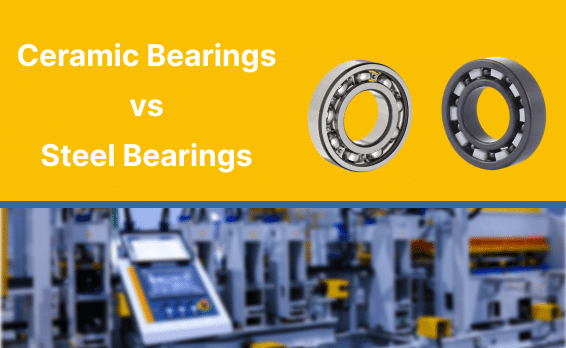
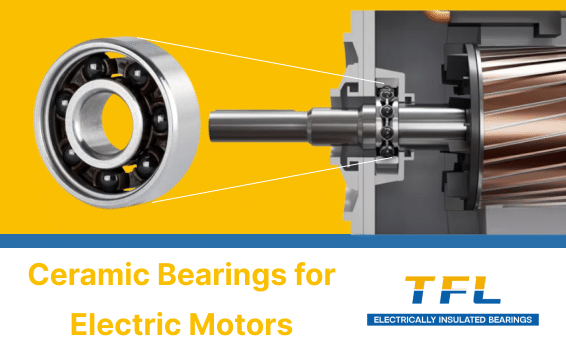
Are ceramic bearings for electric motors worth the cost? In short, yes, if your motor is hot. Where shaft currents, high RPM, or thin grease takes a toll on steel, that upgrade is justified. If you are using clean grease, use steel below 3,000 RPM. For 20 years I have rebuilt both failures.
Fast Facts Before You Spec
- The weight of silicon nitride (Si₃N₄) balls is approximately 60% light compared with steel balls. Hybrid builds run 30 to 40% faster inside the same envelope.
- Ceramic balls do the job on VFD shaft currents, and no brushes wear out.
- Hybrids cannot be self-greased, and grease is still a requirement.
- Payback is in place from 18 to 24 months above 8,000 RPM.
Inside A Hybrid: Rings, Balls And Cage
A hybrid bearing is not a “ceramic” bearing. Only the balls change.
The rings maintain 60 to 62 HRC hardness and remain GCr15 chrome steel, as full ceramic rings will fracture under the press fit stress and are many times the cost. Silicon nitride (Si₃N₄) is the material of the balls, which are ground to a roundness of Grade 5 or better.
At the contact point, that one swap performs three actions. The centrifugal load on the outer raceway decreases dramatically with increasing speed because the mass of the balls decreases.
The contact patch decreases as stiffness increases, and so does friction torque. And the ball does not conduct, and that is why an HC6210-M-P5-C3 build survives the inverter drives that destroy standard steel in nine months.
My old shop foreman promised me that it was covered by a grounding brush, for what that is worth. Brushes wear out.
| Property | GCr15 Steel Ball | Si₃N₄ Ceramic Ball |
|---|---|---|
| Density | 7.85 g/cm³ | 3.2 g/cm³ |
| Hardness | ~700 HV | ~1,500 HV |
| Thermal expansion | 12.5 µm/m·K | 3.2 µm/m·K |
| Electrical behavior | Conductive | Insulating (>10¹² Ω·cm) |
⚠ Pro Tip: Be sure to request a ball grade in writing. Grade 5, compared to Grade 10, moves the noise and runout more than the precision as listed on the cover.
Ceramic Bearings For Electric Motors Guide!
1. What The Ball Swap Changes At The Contact Point
This decrease in density from 7.85 to 3.2 g/cm³ results in centrifugal force against the outer raceway being approximately 60% less at the same RPM. Elastic modulus increases up to approximately 310 GPa, reducing the contact patch, cutting back the friction torque and maintaining the shaft position at any load spikes occurring in the middle of the cut.
- Density Drop: Cages do not crack when travelling at speed, as there is less raceway stress with less mass.
- Modulus Gain: Increased stiffness means tighter positioning, which is initially detected by the machinists in surface finish.
- Heat Signature: Housings usually run 10 to 15°C lower (18 to 27°F) on the same duty with the same load.
2. Why Do Inverter Drives Destroy Steel Bearings?
The common-mode voltage is created on the shaft due to the fast IGBT switching. When current jumps across a ball, a micro-crater is formed in the raceway, after that voltage overcomes the oil film. Millions of arcs then carve washboard fluting, that roaring noise, and spalling far below calculated life.
3. Hybrid, Coated, Or Full Ceramic
Three builds have a battle for the motor seat. Hybrids work on most industrial drives that use an inverter. The ceramic-coated rings 6222/C3VL0241 provide insulation in large frames at lower cost, as they have ≥1,000 V DC breakdown, and there are special models to 3,000 V DC. Chemicals, not shock, is full ceramic.

- Hybrid Ceramic: Steel rings, Si₃N₄ balls, highest speed, best rate, yet requires grease.
- Coated Outer Ring: Layer of Al₂O₃ 50 to 100 µm, dimensionally equivalent to the standard bearing.
- Full Ceramic: They are corrosion-proof and lubricant-free, but only carry about one-third as much load as steel.
4. Speed Limits You Can Actually Bank On
A hybrid performs 30 to 40% better than a steel bearing of the same size moving at the same speed and with lubrication maintained. The reference speed is according to ISO 15312. Grease caps you near 20,000 RPM on 40 to 70 mm bores. Beyond that, the oil-air mist does the cooling, not the ceramic.
- dn Value: Change the bore in mm to RPM and refer to the catalog limit.
- Cage Choice: Wherever stamped steel starts fluttering, there are phenolic or PEEK cages.
5. Preload And Clearance After Warm-Up
This is because ceramic expands approximately one-quarter as much as steel. As a result, a spindle preloaded cold is tighter when the inner ring heats and is not looser. Use re-calculating operating clearance, not copying the steel fit. For General Motors, C3 remains the safe bet.
6. Grease Selection For Motor Hybrids
Ceramic does not buy you any exemption from lubrication. There are still balls rolling on steel raceways, and that joint requires a film. Lithium complex NLGI 2 for general duty, low noise polyurea for continuous heat. Do not mix together thickeners, as the structure of the soap is destroyed and the base oil can be released.
- Base Oil: Do not match viscosity with nameplate speed, rather, match viscosity to measured speed.
- Fill Volume: Approximately 30% of free space, as over-greasing causes churning and overheating of the bearings that can result in damage.
- Interval: Reduce the time by half for each 15°C (27°F) that exceeds 70°C.
7. Sealing Against Contamination And Washdown
Ceramic does not corrode, steel rings can. That difference makes bearings die prematurely, often within a few months, in dairy plants and in pressure wash areas. Use 2RS contact seals with NSF H1 grease, or 440C stainless rings. Hard balls crush abrasive particles, rather than wear against them, and plants gain twice.
8. Cost Per Running Hour, Not Per Piece
A hybrid is three to five times as expensive as a standard bearing. Irrelevant. Four interruptions of $800 an hour for each downtime event put the purchase gap completely under water. Run TCO for one year, and typically the discussion is settled at one meeting.
- Purchase Gap: Roughly $120 to $280 against $30 to $50 in common 63-series sizes.
- Downtime Math: The entire upgrade cost is usually covered by one shutdown.
Which Motor Types Actually Justify The Upgrade?
Three motor families justify the cost: industrial motors driven by inverters with electrical erosion, traction motors in vehicles, and spindle and servo motors running beyond 10,000 RPM. All the other drives, the line fed pumps, fans and conveyor drives below 3,000 RPM, run equally as long, much cheaper, on standard chrome steel.

| Motor family | Typical speed | Build that fits | Field life gain |
|---|---|---|---|
| VFD industrial, 40 to 300 kW | 1,500 to 3,600 RPM | Insulated ring or hybrid, C3 | 2 to 3× |
| CNC spindle / servo | 10,000 to 20,000 RPM | Hybrid angular contact, P4, DB pair | 1.5 to 2× |
| Traction and e-axle | 12,000 to 20,000 RPM | Sealed hybrid, low noise grease | 2×+ |
| Washdown / food duty | 1,500 to 3,000 RPM | Stainless hybrid or full ceramic | 3×+ |
On the spindle side, a hybrid angular contact build such as HCB7007-C is the pair that fits beyond 10,000 RPM.
Traction duty is a topic all in its own right. The EV motor ceramic bearings have been exposed to frequencies of pulses that other industrial fans never experience, with the reduction gearbox only inches away.
A combination of both electrical and thermal sealing is done through a sealed hybrid like 6311/HC5C3. Integrated drive units, where packaging is tightened, is why e-axle ceramic bearings are always specified sealed, pre-greased and matched in pairs from one lot.
If your motor is line-fed, operates at less than 3,000 RPM and is properly greased according to time or conditions, do not upgrade the motor. You would be buying insulation against a current that does not even come into existence.
Proof From The Plant Floor
Numbers cover adjectives, and here are the three measured outcomes of bearing positions we rebuilt.
| Application | Before | After hybrid ceramic | Result |
|---|---|---|---|
| Cement clinker cooler fan | 4 months | 15+ months | Unplanned down time reduced by 70% |
| CNC spindle, 18,000 RPM | 8 to 10 month failures | 24+ months | $27,600 saved annually |
| VFD paper machine motor | Repeat fluting damage | Insulated build | Line uptime restored |
The German servo motor rebuild allowed seeing the mechanism. Use of Si₃N₄ instead of steel rolling elements reduced friction heat sufficiently to prevent spindle drift out-of-tolerance in long cycles. Same housing, same grease schedule, different ball.
These are provided by 50+ pre-audited factories, 5,000+ models and a three-stage QC process of raw material, in process and pre-shipment release. On-time delivery runs 98%.
On a repeat failure at the moment? Submit the part number and a photo of the housing, and you will receive a cross-reference in less than 24 hours.
Bench Habits That Keep A Hybrid Set Alive
Heat, never hammer. The inner ring expands evenly in induction heaters, while a brass drift drives force straight through the ceramic balls and brinells the raceway before the motor even rotates. Always measure shaft and housing first, as a bore 15 µm oversize wipes out the clearance you are paying for.
Here, cleanliness is paramount and more important than for steel. When a hard particle comes into a tight contact patch, it inflicts more damage.
⚠ Warning: Do not install a hybrid at one end and a conductive steel bearing at the other end. The current reroutes, and the other one, the unprotected bearing, will be the failure point.
Re-check for ISO 281 life calculation and ISO 492 tolerance classes. Truthfully, it is frame size and the quality of the grounding, and it can be determined by measuring shaft voltage, rather than a rule of thumb. When converting to ceramic motor bearings there is a need to also consider the IEC 60034-25 guidance on inverter-fed machines.
Sourcing Checklist Before The RFQ Goes Out
- Include the full designation such as HC, P5 and C3 suffixes.
- Use measured housing temperature and RPM instead of nameplate figures.
- Verify drive type, as generally line fed motors do not require insulation.
- Ask for ISO 9001:2015, RoHS and REACH certification before approving.
- Test a pair first in the worst place before the fleet.
Switching to another high-quality brand? Check by suffix, not just bore size, and require documented QC, as there are many counterfeited hybrids and a counterfeit Si₃N₄ ball is likely chosen to be zirconia at half the hardness. MOQ flexibility translates into weeks of production turnaround against the six months lead time of premium brands.
People Also Ask
Do hybrid ceramic bearings still need grease?
Yes, always. There, ceramic balls roll against the steel raceways, and that rolling requires an oil film. Apply low noise polyurea or lithium complex NLGI 2, which is filled in about 30% of free space.
How much more do they cost than steel?
This equals three to five times the amount. A 6310-size hybrid costs $120 to $280 compared with $30 to $50 for a chrome steel, again depending on precision, cage material and order size.
Will ceramic balls stop VFD fluting damage?
In most of the installations, yes. Silicon nitride cuts off the current, which is the elimination of the arcing that carves fluting. A shaft grounding ring still might be necessary on motors over 500 kW.
Can hybrids handle shock loads?
Not well. Harder balls are not tolerant of misalignment impacts and mounting dents, and raceways wear rapidly. Avoid crushers and screens, and keep hybrids in smooth running motors.
What precision class suits a motor spindle?
P5 or P4 for spindles. High performance is achieved by general industrial motors when operating with P6 and C3 clearance, with sub-micron running out only making sense at 10,000 RPM and above.
Conclusion
But price hurts, and there will be no repayment from the slow dirty motors. However, ceramic bearings for electric motors can still recoup their cost within two years when used in VFD and 8,000+ RPM spindles and washdown applications. Have your model list or drawing sent to TFL, and we will give you a free cross-reference within 24 hours. Low-cost bearings, low-cost until the entire line comes to a halt.