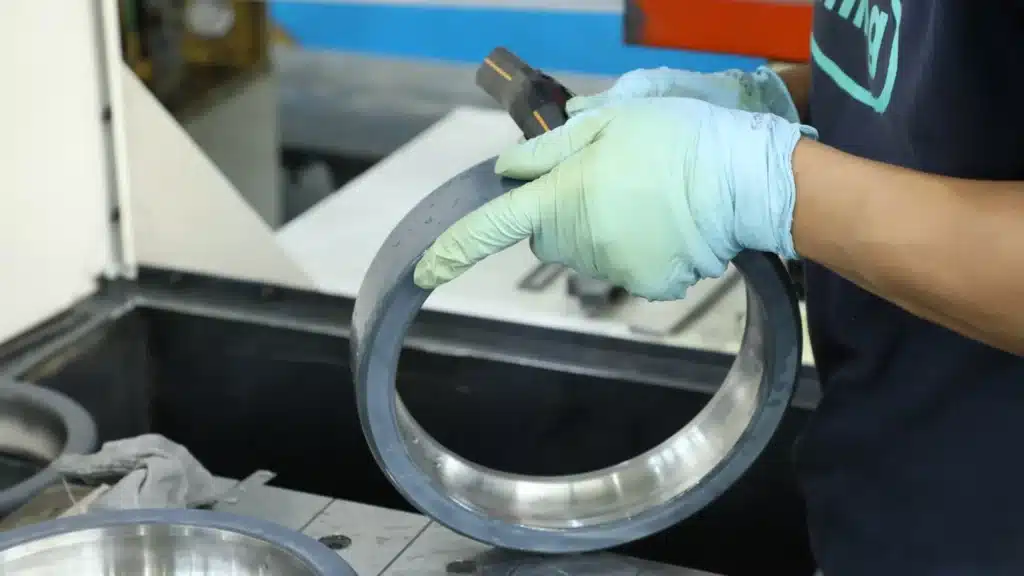


Insulated bearings for motor repair require attention in four areas: identification, replacement, upgrade, and testing. Before dismantling the motor, identify its bearing insulation arrangement and record the full bearing designation. Fit a compatible insulated replacement that meets the original application requirements, unless the motor manufacturer approves a different arrangement.
Deciding whether to upgrade a motor that originally used standard bearings depends on the drive system, current mechanism, and installation. A variable frequency drive (VFD) controls motor speed by switching output voltage rapidly, which can increase the risk of electrical bearing damage. Test the insulation using the motor or bearing manufacturer’s specified procedure and voltage. For VFD applications, a satisfactory DC insulation resistance reading alone does not confirm adequate protection against high-frequency bearing currents.
Key takeaways
- An insulated bearing looks much like a standard one. When identifying, the designation suffix, such as VL0241 or J20GA, is the most reliable clue.
- GAMBICA/REMA installation guide states that a replacement for a factory-fitted insulated bearing must be a compatible type.
- When upgrading, consider insulated bearings when the motor runs on a VFD or the old bearing shows electrical damage.
- Measure across the insulation only, using the specified test voltage and acceptance criteria. Record the test conditions. For VFD applications, evaluate high-frequency insulation performance as well as DC insulation resistance.
- Insulating the motor bearings does not automatically protect a gearbox or pump connected through a conductive coupling. Review the current paths through the complete drive system.
Why Is Motor Repair a Risk Point for Insulated Bearings?
An insulated bearing introduces an electrical barrier to reduce damaging current through the bearing between the shaft and the frame. In a coated bearing, this is typically achieved with a ceramic layer on one ring. Its effectiveness depends on the insulation design and current frequency. Electrical discharges across the lubricant film can erode the raceways. TFL’s guide to insulated bearings vs insulated housings explains the mechanism.
During a rebuild, direct impact or an unsuitable mounting method can damage a ceramic-coated bearing’s insulation. Conductive debris, contamination, or moisture can also reduce effective insulation resistance or create a bypass path. Inspect the coating and surrounding components before reassembly.
Another risk is that an insulated bearing has the same dimensions as the standard version, meaning a standard bearing will also fit. As a result, a technician might overlook the ceramic coating during a busy strip-down and mistakenly fit a standard bearing. The motor may also return to service on a different drive.
The GAMBICA/REMA guide notes that motor manufacturers frequently fit insulated bearings at the non-drive end (NDE, usually the fan side), and it states that “it is essential, if replacing these bearings, that a compatible type of bearing is fitted.”
How Can You Tell If a Motor Has an Insulated Bearing?
1. Check the Designation
| Manufacturer | Insulation type | Designation clue | Example |
|---|---|---|---|
| SKF | Outer ring coated (INSOCOAT) | VL0241 or VL0246 suffix | 6316/C3VL0241 |
| SKF | Inner ring coated (INSOCOAT) | VL2071 or VL2076 suffix | 6317/C3VL2071 |
| SKF | Hybrid, silicon nitride balls | HC5 suffix | 6220/HC5C3 |
| Schaeffler (FAG) | Outer ring coated | J20GA or J20GB; older bearings J20AA or J20AB | 6314-J20GA |
| Schaeffler (FAG) | Inner ring coated | J20GI; older bearings J20C | 6314-J20GI |
| NTN | MEGAOHM ceramic or resin | 7MC, 7MC2, 7MC3, 7MP or 7MP2 code | 7MC3-6330 |
The examples illustrate designation formats, not an automatic interchangeability list. Confirm the complete marking against the relevant manufacturer’s catalog and the motor’s parts specification. TFL’s comparison of 6312/C3 and 6312/C3VL0241 explains the insulation suffix and related replacement considerations.

2. Look at the Bearing
Visual checks can help you confirm the part number. A ceramic coating appears as a matte layer on the outside of the outer ring or inside the bore of the inner ring. On a hybrid bearing, look at the balls. Silicon nitride balls are dark gray or black, unlike the shiny steel rings. If the old bearing is missing or its marking is unreadable, the nameplate or spare parts list can help you identify it.
3. Check for Bridges and Past Records
During dismantling, the US Department of Energy’s model repair specification asks repairers to note any bearing whose insulation has been intentionally bridged. It also helps to check past rebuild records that can show whether an insulated bearing was previously fitted.
Reading the Old Bearing for Electrical Damage
ISO 15243 classifies current-related bearing damage as electrical erosion. During strip-down, inspect for the following signs and assess them together with the operating history and electrical measurements:
- A dull, frosted band on the raceways, which may indicate repeated electrical discharges but requires closer examination.
- Fluting, a pattern of evenly spaced ridges across the raceway. NSK describes these as groove-like corrugations visible to the naked eye.
- Blackened or hardened grease. SKF describes lubricant changes caused by electrical discharge heating, but grease appearance alone does not establish an electrical cause.
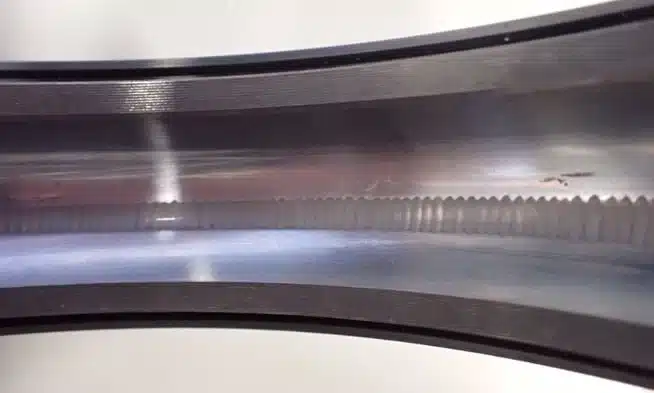
These signs warrant investigation of possible electrical erosion; replacing the bearing without addressing the cause can lead to repeat damage. Where shaft-current pitting is identified, the DOE model repair specification calls for discussing the cause and solution with the purchaser. TFL’s guide to electrical pitting vs fluting shows each pattern.
Why Does Electrical Bearing Damage Appear After a Motor Repair?
If a newly repaired motor fails with fluting, check these causes:
| Cause | What happens | Prevention |
|---|---|---|
| Standard bearing fitted in place of an insulated one | The current path is open again | Match the full designation, including the insulation suffix |
| Insulation bridged | An encoder mount or grounding wire connects the insulated part to the frame | Check every fitting on the insulated side; GAMBICA warns specifically about encoders and tachogenerators |
| Coating damaged during mounting | Coating damage can reduce insulation performance or permit a bypass current path | Follow the mounting rules below |
| Only one end insulated on a motor with discharge current | ABB states that the current then concentrates on the uninsulated bearing | Select protection with adequate high-frequency impedance for both bearings; assess shaft grounding as part of the complete system |
| Motor returned to service on a VFD | VFD operation can introduce damaging bearing currents and early failure under some installation conditions | Confirm how the motor will be driven before choosing bearings |
| Driven machine unprotected | Current passes through the coupling into a gearbox or pump | Assess high-frequency bonding, shaft grounding, and insulated coupling options for the identified current path |
The driven machine also needs attention. NEMA MG 1 Part 31 notes that insulating motor bearings does not prevent bearing damage in other shaft-connected equipment. For shaft-to-earth current paths associated with differences in frame potential, the GAMBICA/BEAMA report emphasizes low-impedance, high-frequency bonding between the motor frame and driven load. An insulated coupling or shaft grounding may also be appropriate, depending on the current mechanism and machine design.
Should You Upgrade to Insulated Bearings During a Rebuild?
A rebuild is a practical time to assess an insulation upgrade because the motor is already open. Compatible insulated bearings are often available with the same boundary dimensions as standard bearings. Before replacement, confirm fits, shoulder geometry, internal clearance, load and speed requirements, and the insulation arrangement. The GAMBICA/BEAMA report advises consulting the motor manufacturer when replacing standard ball bearings with insulated versions.
Consider an upgrade when the motor runs, or will run, on a VFD, or when the old bearing shows confirmed electrical damage. Motor size is a useful screening factor, but it is not a stand-alone selection rule:
- ABB describes one insulated bearing as a common measure against circulating currents in larger motors, typically IEC 280 or NEMA 440 and above. The actual configuration depends on the motor series, drive, and installation; check the documentation for the specific motor-drive combination.
- NEMA MG 1 discusses a 300 mV peak shaft end-to-end voltage criterion, measured according to IEEE 112, in the context of magnetic asymmetry in larger motors, usually 500 frame and above. It should not be used as a universal threshold for high-frequency shaft-to-frame voltage in VFD applications.
- A small or medium line-fed motor with no electrical damage may not need an insulation upgrade. SKF notes that magnetic asymmetry can cause circulating currents in large motors with few poles even without a VFD. Follow the motor manufacturer’s requirements and the findings from the failure investigation.
Select the protection arrangement for the identified current mechanism. Two common cases are:
- Circulating current flows in a loop through both bearings and the frame. A suitably specified insulated NDE bearing can interrupt this path, provided accessories or other contacts do not bypass the insulation.
- Capacitive discharge current can pass from the shaft through either bearing. ABB discusses this mechanism mainly in smaller VFD-fed motors and recommends protecting both bearings with sufficient high-frequency impedance, identifying hybrid bearings as an option. There is no sharp frame-size boundary, and different current mechanisms can coexist. Also assess shaft grounding currents through couplings and the driven machine.
Mounting an Insulated Bearing Without Damaging the Coating
While the ceramic coating is hard, it is brittle and can chip. NTN’s handling instructions for its MEGAOHM bearings provide a clear installation checklist:
- Never drop an insulated bearing or strike it directly with a hammer.
- Do not install a bearing with any visible defect on the insulated surface.
- Follow the manufacturer’s specified shoulder dimensions to prevent adjacent metal components from bypassing the insulation at the bearing side faces.
- Use the housing-entry relief specified for the selected bearing. NTN’s MEGAOHM illustration shows a 10° to 15° relief and a 0.5 mm minimum dimension; follow the applicable drawing rather than applying these dimensions to every insulated bearing.
- Do not attach any electrical conductor directly to the bearing.
Apart from these rules, follow the bearing manufacturer’s standard instructions for heating and fitting. TFL’s insulated bearing installation guide covers tools and methods in more detail.
How Do You Test Bearing Insulation After Assembly?
Use a megohmmeter to measure DC insulation resistance in megohms (MΩ), following the motor or bearing manufacturer’s procedure and test voltage. The DOE’s 1999 model repair specification limits its bearing-insulation test to 500 V DC, but that is a requirement of that specification, not a universal test setting. ANSI/EASA AR100-2025 distinguishes sinusoidal or DC supply applications from VFD applications, which require adequate impedance for the particular drive.
| Reference / application | DC test voltage | Resistance criterion | Scope / conditions |
|---|---|---|---|
| EASA AR100-2025 §4.2.7; sinusoidal or DC supply | Follow the applicable test procedure | ≥1 MΩ | Applies to the stated supply types; not a universal VFD acceptance limit. |
| EASA AR100-2025 §4.2.7; VFD supply | Follow the applicable test procedure | No universal minimum stated for VFD bearings | Evaluate adequate impedance for the specific drive application. |
| US DOE model repair specification (1999) | Not above 500 V DC | ≥10 MΩ | Historical specification; apply where it is the agreed repair requirement. |
| NTN MEGAOHM; catalog 3030/E | 500 V DC | ≥100 MΩ | Catalog product specification; confirm applicability to the selected bearing. |
| SKF INSOCOAT standard layer; 2017 brochure | Confirm the applicable SKF procedure | ≥200 MΩ | Brochure conditions: up to 40 °C and 60% relative humidity; confirm the selected model. |
These values apply to different products, test conditions, and scopes. They are not interchangeable pass/fail limits. Use the acceptance criteria for the selected bearing and motor, and compare readings taken under comparable conditions. An unexpectedly low reading warrants checking the test connections, contamination, moisture, and possible insulation damage. A satisfactory DC result does not establish adequate high-frequency protection in a VFD application.
Isolate the Insulation
Measure across the insulation alone and exclude parallel conductive paths. In an assembled motor, the other bearing, a shaft grounding device, or connected equipment may bypass the insulation and distort a shaft-to-frame reading. Such a reading does not, by itself, isolate the condition of the insulated bearing.
Use the test points and isolation method specified by the motor or bearing manufacturer. A pre-installation bench test can help check the bearing itself, but it does not establish that the completed assembly is free of insulation bypasses. Carry out the specified post-assembly checks as well. TFL’s guide on testing insulation resistance provides additional background; the applicable manufacturer’s procedure takes priority.
Temperature and humidity affect the result. Record both, together with the test voltage, measurement duration, test points, and any components isolated for the test.
Documents to Return with the Motor
The DOE model repair specification calls for signed test records to accompany the repaired motor. For a motor with insulated bearings, a useful handover record also includes:
- The full designation of each bearing removed and fitted.
- The insulated end and the method of insulation.
- The insulation resistance reading, test voltage, measurement duration, test points, and environmental conditions.
- Any electrical damage found, with photos.
- Any recommended measures for the driven machine, such as high-frequency bonding, shaft grounding, or an insulated coupling.
Where permitted by the motor manufacturer and site requirements, a label beside the nameplate identifying the insulated bearing arrangement can help the next technician service the motor correctly.
How TFL Supports Repair Shops and Maintenance Teams
TFL supplies insulated bearings under its own brand for motor repair shops and maintenance teams. Repair jobs may require both insulated and standard bearings; include the complete list in your inquiry so availability and shipment options can be checked together.
For an insulated bearing replacement, provide the full designation, dimensions, internal clearance, cage details, insulated ring location, and original electrical specifications. Matching boundary dimensions alone does not establish suitability. Available sizes, coating specifications, and electrical ratings depend on the quoted model and should be confirmed against its technical data. State whether the original voltage rating is a test, withstand, or breakdown value, together with the test conditions. TFL also supplies hybrid ceramic bearings for applications that require this insulation approach.
Include any certificate, test-report, or third-party testing requirements in the inquiry so their availability and scope can be confirmed for the quoted products. Small or trial quantities, lead times, and delivery arrangements should be confirmed in the quotation.
To submit a request, send the full bearing designation, photos of the markings, the motor make and frame, the drive type, and the quantities through the insulated bearing cross-reference page.
Frequently Asked Questions (FAQ)
1. Can I replace an insulated motor bearing with a standard bearing?
A standard bearing may have the same boundary dimensions, but fitting it can remove the motor’s intended electrical protection. Use one only if the motor manufacturer approves the change for the specific drive system and installation.
2. Can I replace an SKF VL0241 bearing with another brand?
Yes, provided the replacement is verified for the application. Dimensions, internal clearance, cage design, and insulated ring location must match the original requirements or be approved alternatives. Electrical performance must meet the application requirements under comparable test conditions. A larger clearance class is not automatically a better replacement, and a higher DC voltage rating alone does not establish better high-frequency performance.
3. How can I tell if the coating was damaged during mounting?
Inspect the insulated surface before fitting; NTN advises against using a bearing with a visible defect. After assembly, follow the specified insulation test and check for bypass paths. An unexpectedly low reading compared with the applicable product specification under comparable conditions warrants investigation, but it does not by itself prove coating damage.
4. Do inverter-duty motors come with insulated bearings?
Not always. NEMA MG 1 Part 31 sets rules for inverter-fed motors, but Pumps & Systems notes that in everyday use “inverter duty” often refers mainly to winding insulation. Always check the motor data sheet to verify the bearing type.
Technical References/Reading
- GAMBICA/REMA, Installation Guide for Power Drive Systems, 4th edition (2012).
- GAMBICA/BEAMA, Motor Shaft Voltages and Bearing Currents under PWM Inverter Operation, technical report, 3rd edition (2016).
- US Department of Energy, Model Repair Specifications for Low Voltage Induction Motors, DOE/GO-10099-935 (1999).
- ANSI/EASA AR100-2025, Recommended Practice for the Repair of Rotating Electrical Apparatus, clause 4.2.7.
- ISO 15243:2017, Rolling bearings: Damage and failures: Terms, characteristics and causes.
- NTN, Insulated Bearings MEGAOHM Series, CAT. No. 3030/E.
- SKF, INSOCOAT bearings brochure, PUB BU/P2 17401 EN (May 2017).
- SKF Evolution, Prevention of electric erosion in bearings.
- Schaeffler, TPI 206: Current-Insulating Bearings.
- Schaeffler, Current-insulated bearings flyer (J20AA, J20C, HC).
- NSK, Bearing damage by type: electrical erosion.
- ABB, Bearing currents and how to beat them.
- ABB, Bearing currents: options (9AKK107336, 2018).
- ABB, Technical guide No. 5: Bearing currents in modern AC drive systems.
- Pumps & Systems, What is an inverter duty rated motor?
- Machine Design, Shielding bearings: grounding helps inverter-duty motors live up to their name (NEMA MG 1 Part 31).