

Short Answer
An electrically insulated cylindrical roller bearing uses a ring coating or ceramic rollers to reduce damaging current through the bearing. This article focuses mainly on coated NU, NJ, and NUP bearings and their replacement requirements. In electric motors, cylindrical roller bearings are typically fitted at the drive end of medium and large motors with belt or gear drives, where the radial load is heavy.
To specify a replacement, match four things: the design letter, the coated ring and its insulation code, every other code in the designation, and the electrical rating in the maker’s current datasheet. Because the outside dimensions are the same as those of a standard bearing, the full designation, checked against the manufacturer’s documentation, is the primary identification reference.
Key takeaways
- Keep the original design letter as it decides how the shaft is held: NU and N bearings let the shaft move axially, while NJ and NUP bearings hold it in one or both directions
- The insulation code shows the coated ring, such as SKF VL0241 or Schaeffler J20GA (outer ring) and SKF VL2071 or Schaeffler J20GI (inner ring).
- Electrical values change with the document edition and test conditions, so compare figures from the same type datasheet.
- For industrial electric motors, Schaeffler’s initial guidance favors hybrid bearings below 120 mm outside diameter; this is an application recommendation, not a universal size limit.
- Test the insulation after mounting because coating damage or an insulation bypass can reduce protection.
Where Do Cylindrical Roller Bearings Sit in an Electric Motor?
SKF explains that cylindrical roller bearings are typically used in belt- or gear-driven medium- to large-sized electric motors. They carry the heavy radial forces from belt tension or gear mesh.
The drive-end (DE) bearing, on the shaft end connected to the load, is usually the cylindrical roller bearing. It works as the non-locating bearing (it lets the shaft slide slightly along its axis as the shaft warms up and expands). The non-drive-end (NDE) bearing is usually a deep groove ball bearing. SKF’s motor handbook describes it as the bearing that “solely carries the axial loads and locates the shaft in axial direction.”
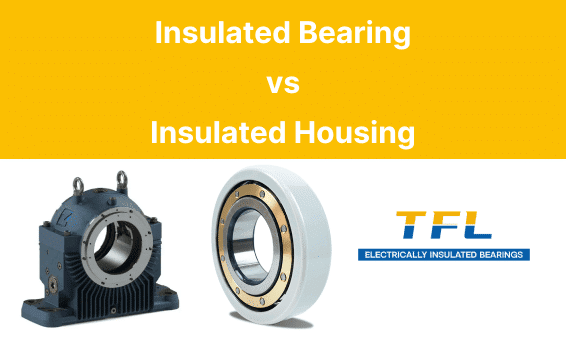
According to ABB, “In general the non-drive-end bearing is insulated.” This means the DE roller bearing is often a standard part, and the insulated bearing sits at the fan end. TFL’s guide to insulated bearings vs insulated housings explains how shaft current damages bearings in the first place.
NTN lists wind turbine generators, traction motors, and VFD motors among the uses of its coated cylindrical roller range. When a motor maker specifies an insulated cylindrical roller bearing, the designation shows it. Before ordering, check the marking on the old bearing or the spare parts list. If it carries an insulation code, the replacement needs one too.
NU, NJ, or NUP: Which Design Does the Motor Need?

The letters before the number describe the flanges, which are the raised lips on a ring that guide the rollers. Where the flanges sit decides whether the bearing holds the shaft in place or lets it move:
| Design | Flanges | Axial movement of the shaft | Usual role in a motor |
|---|---|---|---|
| NU | Two on the outer ring, none on the inner ring | Free in both directions within the permitted displacement range | Non-locating, DE |
| N | Two on the inner ring, none on the outer ring | Free in both directions within the permitted displacement range | Non-locating, DE |
| NJ | Two on the outer ring, one on the inner ring | Free in one direction only | Holds the shaft in one direction |
| NUP | Two on the outer ring; one fixed and one loose flange on the inner ring | Held in both directions | Holds the shaft in both directions |
Risk of a Mismatch
SKF explains that on an NU or N bearing, the ring without flanges accommodates axial displacement of the shaft relative to the housing. An NJ bearing allows that movement “in one direction only.” These movements are limited by the bearing’s permissible axial displacement; locating capability does not imply unlimited axial load capacity.
NU and NJ bearings with the same number share the same bore, outside diameter, and width, so they will physically fit into the same space. If an NJ bearing goes in where the motor was designed for an NU, the drive end starts to hold the shaft in one direction. Depending on its orientation and the complete bearing arrangement, this can restrict the thermal expansion that the original design was intended to accommodate.
To check the old bearing, look at its inner ring. NTN calls the NU inner ring a “straight inner ring,” meaning it has lip-less edges. An NJ inner ring has one lip on one side.
Which Ring Is Insulated on a Cylindrical Roller Bearing?

The coating can sit on either ring. Each maker uses separate codes for the outer-ring and inner-ring versions and publishes its own electrical values:
| Maker and code | Coated ring | Available sizes | Published rating |
|---|---|---|---|
| SKF VL0241 | Outer | Outside diameter above 80 mm | 3,000 V DC; at least 200 MΩ |
| SKF VL2071 | Inner | Bore above 70 mm | 3,000 V DC; at least 200 MΩ |
| SKF VL0246 / VL2076 | Outer / inner | As above | 3,000 V DC; at least 400 MΩ |
| Schaeffler J20GA | Outer, 120 µm | Outside diameter 70 to 800 mm | 3,000 V DC; at least 250 MΩ |
| Schaeffler J20GB | Outer, 200 µm | Outside diameter 70 to 800 mm | 3,000 V DC; 400 MΩ |
| Schaeffler J20GI | Inner, 120 µm | Bore of 70 mm or more | 3,000 V DC; at least 250 MΩ |
| NTN 7MC3 | Outer, 0.2 mm | NU2 and NU3 series sizes | Above 3 kV; above 2,000 MΩ at 500 V DC |
SKF’s 2017 INSOCOAT brochure applies these values to deep groove ball and cylindrical roller bearings. SKF and Schaeffler both start inner-ring coating at a bore of about 70 mm, so smaller cylindrical roller bearings in their ranges are coated on the outer ring. TFL’s inner vs outer ring insulation guide compares the two options.
Datasheet values also depend on when the document was printed. SKF’s 2013 motor handbook rates the basic INSOCOAT coating at up to 1,000 V DC, with every bearing tested at that voltage. The 2017 brochure lists 3,000 V DC for the same standard codes, VL0241 and VL2071. This means an older catalog page, or older stock, can show lower values under the same code.
Test conditions differ as well. SKF’s 2017 values apply at up to 40 °C and 60% relative humidity, while NTN gives its resistance at 500 V DC. A higher MΩ figure on one brand’s sheet is therefore not proof of a better coating.
How Do You Read an Insulated Cylindrical Roller Bearing Designation?
When replacing an insulated cylindrical roller bearing, every part of the designation, not only the insulation code, needs an equivalent in the replacement.
Two published examples from Schaeffler (FAG) and NTN show how the parts break down:
| Code part | Schaeffler NU1018-XL-MP-F1-J20GB-C4 | NTN 7MC3-NU324EGRBC3 |
|---|---|---|
| Insulation | J20GB: 200 µm coating on the outer ring | 7MC3: ceramic coating |
| Design | NU | NU |
| Bore | 18 × 5 = 90 mm | 24 × 5 = 120 mm |
| Internal design | XL: X-life | E: high-capacity |
| Cage | MP: one-piece brass cage | GRB: brass cage |
| Special variant | F1: traction motor variant | None |
| Clearance | C4 | C3 |
Key Technical Variables to Match
- Bore Code: In both brands, from code 04 upward, multiplying the code by 5 gives the bore in millimeters. The NTN example yields a 120 mm bore, a 260 mm outside diameter, and a 55 mm width.
- Internal Clearance: Clearance codes specify the internal clearance between the rollers and rings; C4 clearance is greater than C3 and is not automatically a better replacement.
- Application Variants: Specific suffixes like F1 denote application variants, such as a traction motor build.
SKF uses suffixes after the basic number in the same way, with VL0241 marking the outer-ring coating. TFL’s bearing suffix guide lists the common codes, and the Schaeffler J20 guide covers each J20 variant.
Coated or Hybrid: Which Cylindrical Roller Bearing Fits?
Engineers prevent electrical damage in cylindrical roller bearings using either coated bearings (ceramic-sprayed rings) or hybrid bearings (ceramic rollers). Schaeffler’s initial guidance in TPI 206 considers size together with the motor, converter, and operating conditions:
Coated Bearings
- Mechanism: Aluminum oxide ceramic layer sprayed on the outer or inner ring.
- Designations: SKF suffix VL0241 (outer ring) or Schaeffler J20 series.
- Application: Often considered for larger industrial motor bearings; 120 mm is not a minimum availability limit for coated bearings.
Hybrid Bearings
- Mechanism: Silicon nitride ceramic rollers block the current path between the steel rings.
- Designations: Schaeffler prefix HC (e.g., HCNU210). SKF notes hybrids are mainly used in single-row deep groove ball or single-row cylindrical roller designs.
- Application: Favored below 120 mm outside diameter in Schaeffler’s initial guidance for industrial electric motors; selection remains application-specific.
- Performance (Schaeffler figures): Same dimensions as standard bearings, 20% higher limiting speeds, and twice the grease operating life. Confirm applicability to the selected bearing and operating conditions; these figures are not guarantees for every hybrid bearing.
How to Choose?
For fast-switching frequency converters, Schaeffler recommends either hybrid bearings or coatings with a greater layer thickness. Schaeffler still leaves the decision to the application: “The motor and adjacent parts determine which is the better solution for the respective application.” TFL’s hybrid vs insulated bearing comparison covers the trade-offs.
Insulated Cylindrical Roller Bearing: Mounting and Inspection Guide
According to SKF, the inner and outer rings are mounted separately. The ceramic coating, however, is brittle, so five points need attention:
- Heating: when an induction heater is used, SKF warns that the coating “must not be damaged by the vibration of the heater.”
- Handling: NTN’s rules for its MEGAOHM bearings say never to drop an insulated bearing or strike it with a hammer.
- Housing entry: NTN’s MEGAOHM illustration shows a 10° to 15° entry relief and a 0.5 mm minimum dimension to ease assembly. Follow the applicable bearing and housing drawing rather than treating these as universal dimensions.
- Joining the halves: keep the inner ring aligned with the roller set as the shaft goes in, so the rollers don’t scratch the raceway.
- Clamping: where springs or lock nuts clamp the bearing, SKF recommends a steel spacer ring.
TFL’s installation guide covers tools and heating methods.
ABB states that the insulation must be checked after bearings are replaced. Measure across the insulation alone using the manufacturer’s specified test voltage, connections, and acceptance criteria, as discussed in TFL’s guide to insulated bearings for motor repair. A low reading warrants checking moisture, contamination, test connections, bypass paths, and coating damage. A satisfactory DC insulation resistance reading alone does not confirm adequate high-frequency protection in a VFD application.

How TFL Can Help You Match the Full Designation
TFL’s insulated motor bearing page uses ABB motors as a reference example. It lists four standard cylindrical roller bearings, from NU 319/C3 to NU 326/C3, for the drive end and insulated ball bearings from 6316/C3VL0241 to 6322/C3VL0241 for the non-drive end. This matches the arrangement described earlier, so both ends of a motor can be sourced together. TFL handles such mixed lists as one purchase order with one consolidated shipment.
Where the drive end also needs insulation, TFL offers its own brand of insulated cylindrical roller bearings with an aluminum oxide (Al₂O₃) coating on either the outer or the inner ring. Coating specifications and electrical ratings depend on the selected model and should be confirmed in its technical data. Include the original insulation code, electrical rating, and test conditions in the request. For smaller motors, TFL also supplies hybrid ceramic bearings.
Before quoting, TFL’s engineers compare the size, suffix, tolerances, and load rating with the original SKF, FAG, NSK, or NTN bearing. Quotation timing and availability are confirmed for each inquiry. To start, send the full designation, photos of the markings, and the drive type through the insulated bearing cross-reference page.
Frequently Asked Questions (FAQ)
1. Is an insulated cylindrical roller bearing the same size as a standard one?
Yes. The external dimensions follow DIN 616 (ISO 15), and Schaeffler states that current-insulated bearings are interchangeable with standard bearings. However, the design letter and every suffix must still match the original.
2. Can I replace an insulated NU bearing with a standard NU bearing?
A standard bearing will fit, but the motor will lose its electrical insulation barrier. Stray current can pass through again and cause electrical damage. Keep the same insulation code unless the motor manufacturer confirms otherwise.
3. Can a motor with a cylindrical roller bearing be test-run without a load?
A long run without load carries a risk. SKF states that ball and roller bearings must always be subjected to a given minimum load. Without it, the rollers can skid (slide instead of roll) on the raceway. NSK warns that such sliding damage, which acts upon the raceway, ultimately results in bearing seizure. First, check the bearing maker’s minimum load.
4. Does the drive-end cylindrical roller bearing also need insulation?
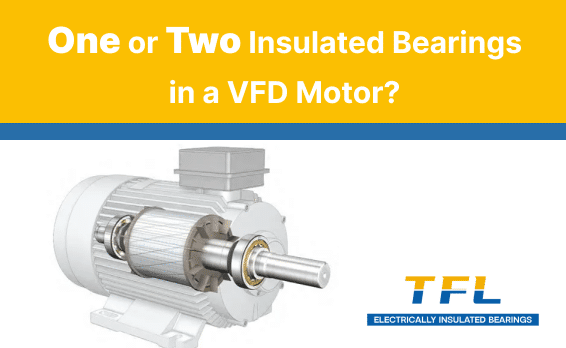
Insulation placement depends on the motor and the type of current. One insulated NDE bearing breaks circulating current in larger motors. ABB links discharge current mainly to motors below IEC frame 250 and recommends protecting both bearings there. See TFL’s guide to one or two insulated bearings in a VFD motor.
Technical References
- SKF, Cylindrical roller bearings for large electric motors, PUB BU/P2 14960 EN (April 2015).
- SKF, Rolling bearings and seals in electric motors and generators, PUB 54/P7 13459 EN (August 2013).
- SKF, INSOCOAT electrically insulated rolling bearings, PUB BU/P2 17344 EN (May 2017).
- Schaeffler, TPI 206: Current-Insulated Bearings, edition 03 (May 2024).
- Machinery, Bearings with optimised coating offer improved protection against current passage (Schaeffler J20G series).
- NTN Americas, MEGAOHM cylindrical roller bearings for electric motors, spec sheet 21NTNMOCRB.
- NTN Americas, 7MC3-NU324EGRBC3 product data.
- NTN, Insulated Bearings MEGAOHM Series, CAT. No. 3030/E.
- ABB, Motor bearings: the bearing necessities, Global Cement Magazine (October 2007).
- ABB, Bearing currents and how to beat them.
- NSK, BRGCALC: Calculating required minimum load for CRB.
SKF, INSOCOAT, Schaeffler, FAG, X-life, NTN, MEGAOHM, NSK, and ABB are trademarks of their owners. They are named only to identify technical sources and product designations. TFL is not affiliated with these companies, and naming them does not imply identical performance.